
Special bio-receptive tiles to be used to ‘offset habitat losses’ in Whitby

A charity is hoping to ‘offset historical habitat losses’ in the Whitby estuary by installing almost 100 bio-receptive tiles and rock pools.
Currently, the Whitby estuary on the River Esk has ‘moderate’ ecological potential but experts hope that plans to support wildlife could see it get a ‘good’ rating by 2027.
Groundwork North East & Cumbria (GNEC) has said that its plan to install 95 bio-receptive tiles and six artificial rock pools to the disused slipway at Whitehall Landing, Whitby would attract new species and improve biodiversity.
If plans are approved by North Yorkshire Council, the tiles would be bolted onto the existing concrete surface of the slipway, around 200m to the north of the A171 road bridge at Whitby.
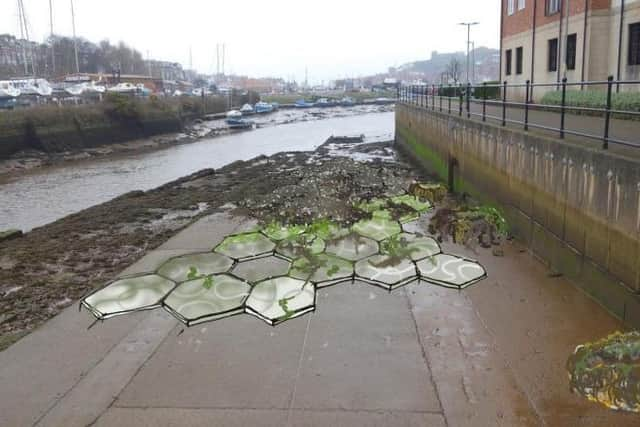

The estuary is classified as a “heavily modified water body” due to the artificially diverted, widened, deepened, and straightened channels which has led to “reduced habitat diversity”.
According to GNEC, a charity that has operated in the region for more than 30 years, increasing the complexity of the texture and pattern on the bare concrete surface is expected to “encourage colonisation by seaweeds and green algae, and inhabitation by mollusc and crustacean species”,
This would help support and attract “nationally important species such as water vole, kingfisher, dipper, brook lamprey, salmon, and freshwater pearl mussel”.
Currently, three types of seaweed are present towards the lower end of the slipway while towards the top end of the ramp, no vegetation was recorded.
As part of the scheme, GNEC has engaged with the local community with two workshops at East Side Community Hub and Green Lanes Community Centre, where the proposals were presented and a clay modelling activity took place to create components to be included in the proposed installation.
The applicant said it had delivered interventions to support ecological enhancement on the Esk over the past five years, including the creation of an intertidal terrace using brushwood fascines at Whitehall Landing to protect and establish saltmarsh and a similar scheme at Black Shed, as well as trials of various bio-receptive panels and artificial rock pools within the harbour area.
The charity said: “Whilst contributing to water quality improvements and wider ecological benefits, the greening of the banks also brings carbon capture benefits.
“These interventions also can provide aesthetic wins and help to connect the local community to the river.”
North Yorkshire Council has not set a date for deciding on the application which is currently pending consideration.