
North Sea collision: A mysterious collision and a wildlife disaster just avoided


Mystery surrounds the collision of two huge ships in the North Sea, just miles from Yorkshire’s east coast but an environmental catastrophe looks to have been avoided. Alex Wood reports
Locked in a fiery embrace as flames leapt from hundreds of tonnes of jet fuel gushing onto the sea the two burning ships presented rescuers with a truly apocalyptic scene. The collision of the two leviathans was followed by a massive fireball and multiple explosions. Thirty-six crew were recovered but one seafarer remains - in the bleak language of officialdom - “unaccounted for”.
Something had indeed gone “terribly wrong” 13 miles off Yorkshire’s coast as Maritime Minister Mike Kane later told MPs.
What exactly led to the Portuguese flagged cargo ship Solong ploughing into an oil tanker at the equivalent of 18mph is something investigators are beginning to unpick as they take statements from the crews involved.

When the vessels are finally safe to board, officials will retrieve their “voyage data recorders” - similar to the black boxes carried by aircraft.
Designed to withstand extreme conditions like fire, they’ll allow investigators to reconstruct events leading up to the collision - details like the ships’ speed, heading, bridge audio and radar data.
Two inquiries are ongoing - Humberside Police has arrested the 59-year-old Russian captain of the Solong on suspicion of manslaughter by gross negligence. He remained in custody on Wednesday.
At the same time the Marine Accident Investigation Branch it leading an inquiry, with Portugal and the United States acting as “substantially interested” states.
Its purpose is not to point the finger of blame, but to try and ensure lessons are learned.
Solong frequently travelled between Grangemouth and Rotterdam and regularly used the route it took on the day of the collision
The container ship, which was carrying alcohol, but was initially thought to be carrying sodium cyanide, took a course directly down the East Coast. She was due to arrive in Rotterdam on Monday evening.
Meanwhile the Stena Immaculate was at anchor, with a cargo of 220,000 barrels of aviation fuel from a Greek port and was waiting to go into Killingholme on the River Humber to unload.
The ship was one of three Crowley-operated and Stena-owned tankers on a short-term charter with Military Sealift Command, a US Navy organization that transports military supplies and equipment worldwide.
Luckily given what was about to happen the kerosene-type fuel she was carrying has a less-lasting impact on the environment - it seems - than a shipment of heavy oil.
Those on board Stena Immaculate had no clue disaster was about to strike.
Still travelling at a speed of 16 knots, Solong’s bow “T-boned” Stena Immaculate midships at 9.47am, rupturing at least one of her 16 tanks carrying hundreds of tonnes of fuel.
It appears that as Solong’s bow penetrated the tank, fuel cascaded onto the smaller ship - and both went up in flames, with the sea now covered in a thin film of oil also igniting.
A sailor on board Stena Immaculate told American news channel CBS News how the “massive ship came out of the blue” leaving him only seconds to prepare for the impact.
He said the ship didn’t stop immediately and appeared to carry on as if “nobody was on the bridge of the Solong at the moment of the crash”.
Crew members followed well rehearsed procedures and donned protective clothing to fight the fire but soon realised it was impossible and abandoned ship.
The unnamed sailor said flames were lapping at the lifeboat and were so close that some of the seamen even had singed hair.
Stena Immaculate’s captain was the last person to leave the stricken ship.
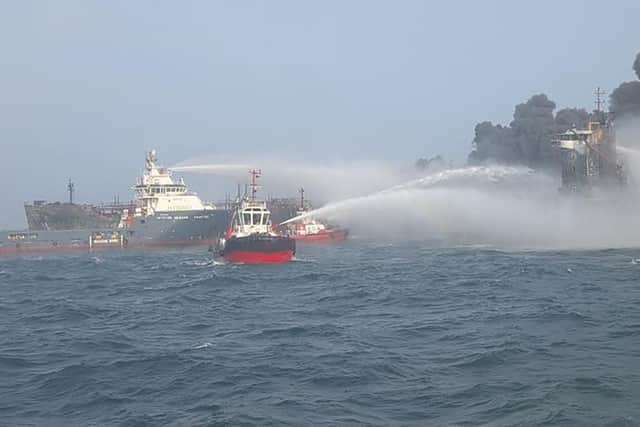
A flotilla of rescue ships were quickly at the scene of what is an extremely busy entry point to the Humber Estuary as Mr Kane told MPs: “The emergency services were on scene swiftly and their action saved many lives”
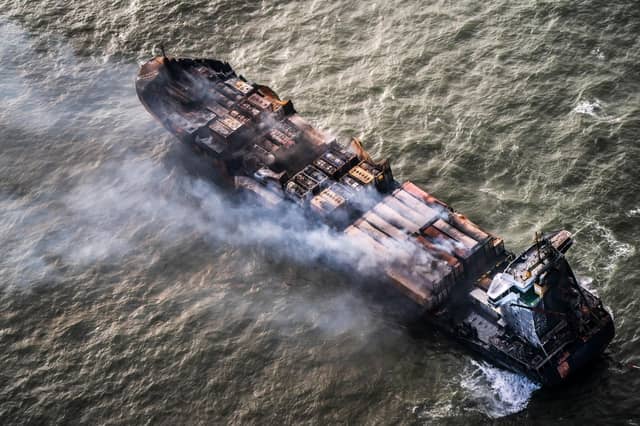
After a night entangled, MV Solong broke free and began to drift southwards, images showing smoke still rising from her charred remains, burned out containers and crumpled bow.
For some time it was thought the blackened hulk would join hundreds of other shipwrecks of the East Coast on the bottom of the North Sea. But she is now expected to remain afloat and be salvaged.
In the meantime MV Stena Immaculate, with a gaping hole where she was hit midships, remains at anchor around 13 miles off Withernsea.
So far the authorities say there has been no further reports of pollution from either vessel following the initial incident.
Much of the kerosene is thought to have burned off and what escaped would have formed a thin film which should evaporate or naturally disperse within the coming days and months.
Dr Paul Johnston from the Greenpeace Research Laboratories, said: “We’re not quite out of the danger zone yet, but it’s starting to look like an environmental disaster may have been narrowly averted.
“When a container ship the length of a football pitch rams into a tanker carrying thousands of tonnes of jet fuel at 16 knots close to sensitive nature sites, the potential for serious harm is huge.
“This incident is a stark reminder of the inherent risks associated with millions of tonnes of oil and oil products floating in tankers on our oceans each and every day.”
A Torres Canyon?
“We are not going to see a Torres Canyon”, says Mike Cohen, chief executive of the York-based National Federation of Fishermen’s Organisations, referring to the tanker which hit rocks off the coast of Cornwall more than 50 years ago, spilling more than 100,000 tonnes of crude oil into the English Channel.
Beaches were left knee-deep in sludge and thousands of sea birds were killed in what remains the UK’s worst environmental accident.
It is still early days and Mr Chen says there are still a lot of unknowns.
What was in the containers Solong was carrying? Is anything leaking from the ships?
Aerial surveillance flights on Wednesday did not identify any pollution on the surface of the water, HM Coastguard said. And water sampling so far hasn’t shown pollution.
That will be a huge relief to the dozens of fishermen working on what is one the most important shellfishing regions in Europe.
Few people realise that Bridlington is Europe’s lobster capital, or that the majority of the delicious shellfish landed in the port ends up gracing the tables of restaurants and hotels in Spain, France and Portugal instead.
However Mr Cohen says the aviation fuel the tanker was carrying is not going to end up in the human food chain.
Mr Cohen said: “It’s a light fractional oil which makes it super toxic - if any animal comes into contact with it it is likely to kill it - but it makes it float and evaporate.
“It doesn’t sink to the seabed. Ultimately that will be its saving grace.
“It is not going to end up in the human food chain. We are not going to see this affecting anything fishermen might catch.”
Both vessels were powered by diesel - not as toxic as aviation fuel and it also floats, so should be containable.
Mr Cohen said: “There’s vessels on site keeping a very close eye on things. We haven’t got any reason to think anything has gone wrong yet.”
At Bempton Cliffs where seabirds are beginning to gather for this year’s breeding season staff are conducting daily checks for any signs of pollution. Hundreds of thousands of seabirds, including gannets, puffins, and razorbills come to breed on Flamborough Head every year.
Many seabird populations are already struggling - not least because of avian flu.
However so far, so good, with no reports yet of pollution.
But Prof Alastair Grant, from the University of East Anglia’s School of Environmental Sciences, said although much of the fuel would have burned off it was wrong to assume it would all simply evaporate.
A change in wind direction from Wednesday could mean it floats as far as north Norfolk.
“Jet fuel has a high boiling point, so will evaporate only slowly,” he said. “It contains up to 25 per cent aromatic hydrocarbons, which are relatively toxic and slow to break down in the environment.
“Whereas crude oil forms the black slicks on the surface that are so familiar, this will spread out as a thin film. So it will be less visible but it will spread over a larger area.”
Merchant Navy
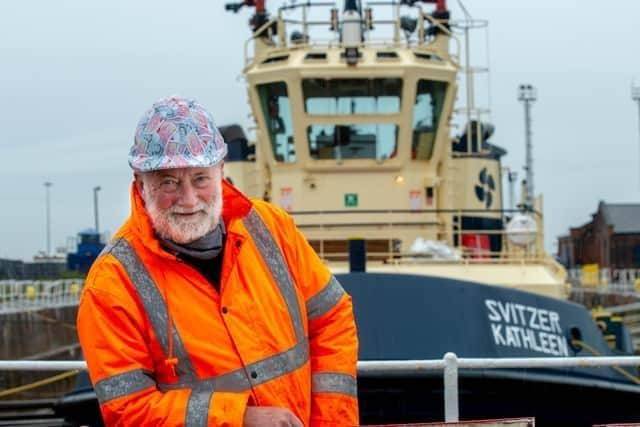
“Poor seamanship” is likely to be to blame for the disaster, says Dave Roberts (inset), who has been chairman of independent lifeboat Humber Rescue for more than two decades.
Mr Roberts spent 36 years as a self-employed industrial chemist, working mainly in shipping, after coming ashore from the Merchant Navy.
He said: “You have to have two people in attendance on the bridge - an officer of the watch and a lookout. They also have a watchkeeper’s alarm which you press every 12 minutes. If you don’t press it an alarm goes off in the captain’s (cabin).
“There will probably have been an anti collision system on the radar which will tell you if vessels in the area are going to be in collision with you.”
He says ships the size of Solong - which had a crew of 14 - would once have had far more sailors. “When I went to sea initially on a tanker we had a crew of 80 - they are just cutting people down all the time.
“You’d think because of the area they (Solong) was going into they’d be very attentive.
“It wasn’t as if you are in the middle of the Atlantic - you are in congested waters.
“I don’t think visibility was that grand, but usually (in that situation) the Captain is on the bridge as well as the officer of the watch with the engine room on standby.”
Worryingly, according to the Marine Accident Investigation Branch, alarms designed to warn of dangerous situations are commonly disabled.
A safety study the MAIB conducted alongside Danish authorities showed many operators disabled the alarms or ignored alerts.
The MAIB has records of 63 incidents including collisions and vessels running aground.
They found common safety issues included a lone bridge watchkeeper, system alarms that were either disabled or not set effectively, alcohol being consumed and hours of work and rest records being falsified.
Previous analysis of accidents involving merchant vessels of over 500 tonnes found in two-thirds of the cases a proper lookout wasn’t being kept.