
If we can’t trust the BBC, what public body can we trust? - Jayne Dowle
Just when you thought the news couldn’t get any more mind-boggling, along comes the President of the United States threatening to sue the UK’s national broadcaster for $1bn (£760m).

A leaked internal memo said that a Panorama programme aired in October 2024 misled viewers by splicing together two parts of a speech Trump made on January 6, 2021, making it appear as though he was explicitly urging people to attack the US Capitol after his 2020 Presidential election defeat.
With a deadline of tomorrow, President Trump is demanding an apology from the BBC for making “false, defamatory, disparaging, misleading, and inflammatory statements”, a “full and fair retraction” of the offending documentary, and for the corporation to “appropriately compensate” him.
That’s not all. The memo also accuses the BBC of issues within its Gaza coverage, particularly by BBC Arabic, anti-Israel bias and one-sided transgender reporting - among other “troubling matters”, it’s reported.
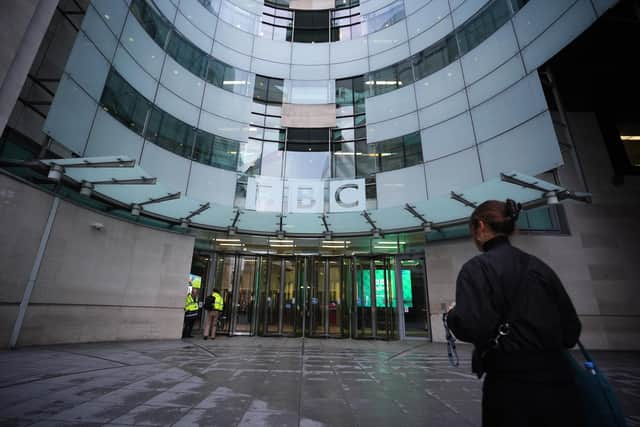

It’s a huge and unravelling mess that’s already seen the resignation of BBC Director General Tim Davie and the head of news, Deborah Turness.
And whatever happens by Friday, the British public are left wondering – if we can’t trust the BBC, what public body can we trust?
Resignations and recriminations won’t stop the feeling that once again, we are being let down by yet another institution. This does nothing positive for the already restive public mood.
Left to answer questions on behalf of the government on Good Morning Britain earlier this week, local government minister Alison McGovern insisted, “let's not have a big drama about it. Let’s just crack on. Deal with issues as they are and focus on good quality journalism.”
Which is missing the point by several miles. The watching and listening public deserve to know what’s really going on at the BBC.
We pay our licence fee, which accounted for 68 per cent of the BBC’s funding in 2023/24. The remainder of the BBC’s finances comes from commercial activities and grant funding from the government, specifically the Foreign, Commonwealth and Development Office, which supports the BBC World Service.
The issue of what we get for our money is particularly piquant as next month, the government is expected to start a consultation into the BBC’s new charter, which will look at alternative models of funding, including advertising and subscriptions, from 2028.
However, more importantly hangs that big question of trust. A fairly recent major audience survey found that 60 per cent of UK adults believed BBC News to be a trustworthy source of information.
Kantar Media surveyed 13,496 people using BBC News in the year 2022-23, with the majority, regardless of age, gender, socio-economic group or geography, giving a positive score. It would be interesting to know what those same people thought today.
Interestingly, positive scores were higher in London, among ABC1 social groups, and among viewers and listeners aged 35-plus, lower among C2DE groups, 16–34-year-olds, and in Scotland and Northern Ireland.
What this Trump debacle illustrates is a point my own two 20-something son and daughter have been arguing for a while; mainstream media such as the BBC holds itself in high regard and purports to follow exacting standards, but it can be biased, nuanced and even downright distortive.
My kids would never turn directly to the BBC for their immediate source of news, but rely on an array of other outlets, some of which I find highly questionable. Their late father, who worked as a studio engineer for the BBC World Service, would be bemused.
He always abided by the values of Lord Reith, the BBC’s first director-general, that the purpose of the British Broadcasting Corporation was to “inform, educate and entertain”, a mission that should be “distinctly regarded as a public service”.
But who’s right and who’s wrong? I’m seriously beginning to see the younger generation’s point. And I say this as a journalist who understands that sometimes, in the interests of strengthening a story for whatever reason, liberties are taken, indeed, quotes are spliced, sentences truncated and run together. I’ve seen it happen countless times on a harried newsdesk with an editor demanding a powerful front-page splash.
Surely however, any editor would take extra-special care over a story involving such a massively high-profile and litigious figure as Donald Trump. And would consider the edicts of the BBC’s 436-page editorial guidelines, a tome former BBC journalist and commentator Polly Toynbee calls, “the nearest journalism has to a holy bible on impartiality and good judgment”.