
'Jeremy Clarkson effect' is getting more teenagers to consider farming careers: Jayne Dowle
Hurrah for Jeremy Clarkson. He might not have much faith in A Levels, but he certainly knows how to inspire the young folk.

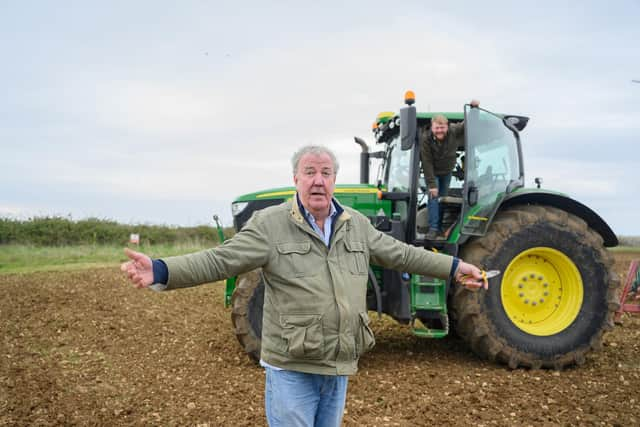
His Amazon Prime TV series Clarkson’s Farm is encouraging more teenagers to sign up for land management degrees, helping to secure the future of rural life, farming and food production at a time when it’s never been more necessary.
That’s according to the Royal Agricultural University (RAU) in Cirencester, Gloucestershire, which reports an 11 per cent increase in applications for its three-year rural land management BSc course compared with last year.
There’s an even higher jump in students keen to get their hands dirty. Applications for the land management degree which includes a farm placement are up 18 per cent year-on-year. Meanwhile, applications for the university’s two-year rural land management foundation degree rose by 14 per cent.

Interest in three-year agriculture courses climbed 4 per cent, and agricultural courses with farm placements grew 8 per cent. The university says that whilst it’s witnessing an upward trend in both specialisms, the interest in land management is particularly impressive.
“It’s looking like programmes like Clarkson’s Farm are having an effect,” says Daniella Miles, RAU’s head of student recruitment. “The interest goes beyond ‘I can do farming’, there’s also rising enthusiasm for the range of professional roles involved in making farms succeed.”
Who would have thought it? Perhaps Education Secretary Bridget Phillipson might like to take a look at these admissions figures and ponder a while about aspiration. It’s not just an urban thing.
Whilst much is made of encouraging young people from less-privileged backgrounds to aim high and go for university degrees, the usual line is to push them towards ‘STEM’ (science, technology, engineering and maths) subjects.
This is frustrating, ignoring entirely the fact that such subjects – certainly at undergraduate level – require natural ability and facility with numbers, not qualities that all young people possess.
University graduates in the UK are facing the toughest job market since 2018, according to research published by the job search site Indeed in June.
With AI threatening jobs for humanities graduates and the pursuit of languages at degree level looking ever more woeful, it’s clear that students are beginning to consider studying for careers which might have seemed unattainable or in the past, or open only to those with traditional rural backgrounds.
As employers pause hiring and use AI to cut costs, the number of roles advertised for recent graduates is down 33 per cent compared with last year, the lowest level in seven years, according to Indeed.
Research from the Organisation for Economic Co-operation and Development finds AI technology is likely to especially disrupt “white-collar” professions such as lawyers, doctors and software engineers.
It can be a miserable world out there for the recently-graduated, thousands of pounds in debt and with no prospect of employment any time soon.
Is it any wonder that teenagers are beginning to look into working on the land? After all, however automated farms and rural businesses might become, there will always be rurally-based roles that can only done by a real, live human being.
The farming industry is clearly leading the way when it comes to philanthropy too. Tractor driver-turned-farm manager Kaleb Cooper, who has gathered legions of fans through Clarkson’s Farm, launched a RAU bursary scheme in 2023 to support students without agricultural backgrounds. Successful applicants receive a £3,000 grant and the opportunity to apply for a work placement with Cooper or his partners.
Other agricultural colleges, including Harper Adams University in Shropshire, also report a “ripple effect” from the TV show. Clarkson’s land agent and agronomist ‘Cheerful Charlie’ Ireland is proving himself as a particular poster boy for careers on the land, according to lecturer Andrew Black, who says Ireland’s role on Clarkson’s Farm has sparked curiosity among prospective students.
The combination of Clarkson’s celebrity status and his well-known lack of farming and land management knowledge when he set out at Diddly Squat has helped to make his experience relatable.
Whether it’s just the ‘Clarkson effect’ or input too from the wonderful farming-oriented TV shows made in our own region, such as the trio featuring the Owen family on their remote hill farm in the Yorkshire Dales – Our Yorkshire Farm, Our Farm Next Door and Beyond The Yorkshire Farm – and A Yorkshire Farm, following the Nicholson family at Cannon Hall Farm in Barnsley, South Yorkshire, there’s certainly a compelling cross-over taking root.
And ultimately, this can only be good for the country, in all senses.