
Keir Starmer reminded me of 1984's Big Brother with Orwellian war speech: Jayne Dowle
I heard Sir Keir Starmer’s defence speech on the radio and listening to his disembodied voice made me think I was in the canteen with Winston Smith.


If you remember, in 1984, George Orwell’s dystopian novel, Oceania – of which Britain was part – was perpetually at war with either Eurasia or Eastasia, no-one could quite remember which.
All that was missing were the overalls, the ‘pinkish-grey’ stew for lunch and Victory coffee, but given the foreboding tone of the government’s strategic defence review (SDR), these will surely only be a matter of time.
‘Plan for Change’, ‘Peace through Strength’, there was definitely something Orwellian about the Prime Minister’s tone this week, enough to send a chill through the soul of anyone who already fears for the future. Most of us will not remember being on a global war footing; it’s going to take a massive shift in consciousness to come to terms with this.

I know the SDR is meant to reassure us – ‘everyone should feel safe and secure at home’ as Starmer said – but all this talk of war does nothing for the anxiety levels. Already feeling cynical, I wondered, yet again, why recent governments have turned to fear as their own weapon.
It started during the Covid pandemic under Boris Johnson’s Conservative government, when we were made to feel terrified to even leave our homes. ‘Don’t kill granny’ as the brutal message went. Then Chancellor Rachel Reeves, almost as soon as she arrived at the Treasury in July, started to tell us to prepare for pain. That became real with the immediate cut to pensioners’ winter fuel payment and rises in National Insurance payments for employers, for example.
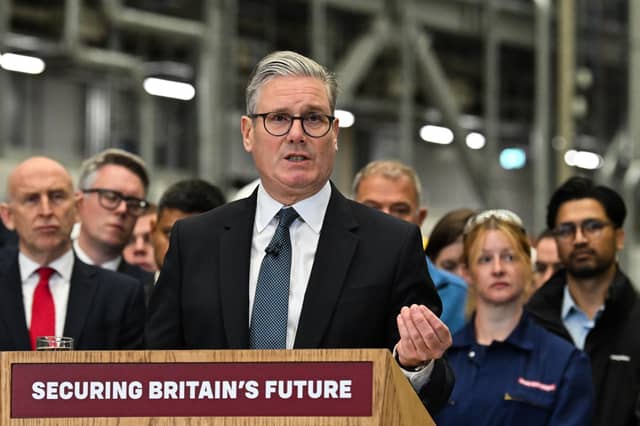
And now, with Starmer in full battle mode, speaking from the Govan shipyard in Glasgow, warning us that full-scale war is both imminent and likely, I felt like getting under the kitchen table and staying there.
He wasn’t mincing words as he delivered his summary of the report, Making Britain Safer: Secure at Home, Strong Abroad, a 140-page, 48,000-word document, the first root-and-branch review of defence in more than a quarter of a century.
General Sir Richard Barrons, part of the review team and the former head of joint forces command, described its vision as ‘the most profound change’ to UK defences in 150 years.
Starmer described China as a ‘sophisticated and persistent challenge’ which has missiles that can reach the UK and Europe. Russia is an ‘immediate and pressing threat’ which could rebuild its land capabilities quickly in the event of a ceasefire in Ukraine and head westwards again.
There was nothing unequivocal about Starmer’s words. Britain will be transformed into a ‘battle-ready, bomber-clad nation’, whether we like it or not. So we had better put away our soft, liberal things and get ready for a future where our children will carry out ‘gap years’ on military service, the army will rise in number to 100,000 soldiers, and what Starmer calls the ‘war dividend’, will benefit our economy, ‘creating thousands of jobs and supporting working people across the country’.
All this war preparation is going to mean a massive upskilling in the UK’s armaments; ‘defence’ will become a major economic player. The government plans to invest £15 billion in sovereign nuclear warheads and buy up to 12 attack submarines, developed under the Aukus partnership with Australia and America, which is already building nuclear subs at Barrow-in-Furness in Cumbria.
Up to 7,000 UK-built long-range weapons will be procured and £1.5 billion spent on at least six munitions and energetics factories to produce hardware and explosives, Starmer confirmed.
If we are to face war, then this Labour government should ensure that we face it fairly. When Starmer and his team get out the maps and start looking at where these factories are best situated, our region should be top of the list.
In the steel city of Sheffield, we already have a centre of advanced manufacturing and engineering, with specialisms including aerospace, and companies such as Boeing, McLaren and Rolls-Royce in situ. We’re told that a new way of fighting wars, with swarms of drones followed by tanks, armoured vehicles and attack helicopters, will be developed. All of these must be built somewhere, so why not here?
Our former coalfields, now home to diverse industries including logistics, retail and service providers, prove that we are no strangers to reinvention in South Yorkshire. And to the north of our region, it makes sense to hook up with the proud manufacturing and steel-making history of the North East.
Let us trust that Secretary of State for Defence John Healey, MP for Rawmarsh and Conisbrough, will fight our corner as we prepare for the biggest fight of our lives.