
The fervent atmosphere surrounding the Prime Minister is dangerous for the country - Jayne Dowle
By the time you read this, all the chess pieces could have shifted again, but the question remains, what is really going on at the heart of our government?

Last week, headlines suggested that the Prime Minister, Sir Keir Starmer, was facing a leadership challenge. Health Secretary Wes Streeting was in the frame as the perpetrator; cue some confusing hours in which sources inside Downing Street insisted that nobody had accused Streeting of plotting a coup.
But still, someone was apparently making calls to political journalists briefing them that Streeting was on manoeuvres. If that wasn’t the case, what was happening?
Then, inexplicably, the name of Doncaster North MP and Energy Secretary Ed Miliband, who served as Labour leader from 2010 to 2015, was thrown into the mix. Miliband swiftly rebutted the suggestion, claiming that once was quite enough for him.
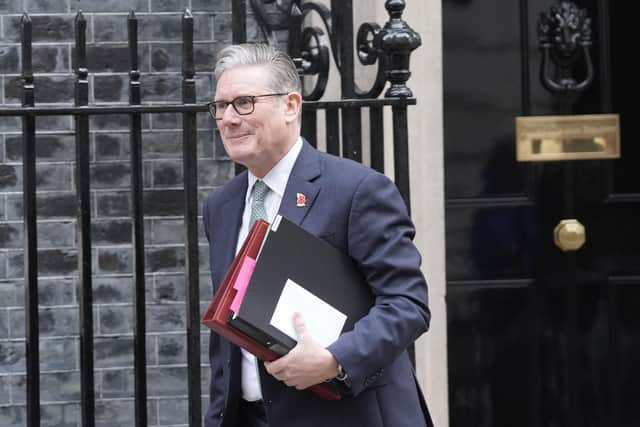

Most of us, trying to get through our daily lives without worrying too much about what the budget might bring on November 26, will have given up trying to fathom it out. But not only is the fervent atmosphere surrounding the Prime Minister unsettling, it’s dangerous for the country.
Not only in terms of our standing in the wider world, but for our own sense of security. It’s terrible for the public mood; if nothing else, a Prime Minister should appreciate this.
Living in the UK right now is like being on an unsettling switch-back ride. Such as when the Chancellor of the Exchequer looms onto breakfast TV to tell us all to brace ourselves for a punishing budget, by which everyone assumes means a manifesto-breaking move to raise income tax. But then, in a transparent attempt to quell backbench revolt, she goes into reverse and we learn she’s not going to do this after all.
Rachel Reeves is the second-most powerful person in the Cabinet, yet she is somehow being allowed to hold the country to ransom, sowing anxiety and fear.
Into the vacuum swirls rumour, accusation and a constant stream of conflicting information.
Never has it been more necessary for a Prime Minister to dig deep and get a grip, if only to steer us through the next few months.
Yet amongst all the questions being asked, the major one is, why can’t Starmer – yet again – read the room? And actually be in the room. His country needs him, yet he’s spent more than a sixth of his time as PM travelling abroad on foreign trips, having completed six full laps of the Earth. This is a luxury perhaps afforded only to world leaders who have a secure base at home.
Starmer has visited 44 countries on 37 trips out of the country to attend conferences, bilateral meetings and sports fixtures. This means he’s travelled more and further than any other British leader in official history, it’s said; almost double the distance that Sir Tony Blair covered in the same period in office.
No wonder it’s reported that ministers have called for him to “get off the plane” and focus his attention on the UK.
New research from More in Common, an international organisation dedicated to fostering more inclusive societies, finds that more than a third of Britons think Starmer is spending too much time abroad. About a quarter said he was overseas about the right amount. Among Reform UK voters, two thirds said that he spent too much time abroad.
Luke Tryl, from More in Common, said that Starmer’s time abroad was constantly raised in focus groups. “It is just the sheer volume for people,” he said. “People are quite zero-sum when it comes to politicians. They think if he’s not here, he’s focusing on something abroad, it means he’s not focused on the cost of living.”
The events of last week should have served as (yet another) wake-up call to Starmer, but it’s doubtful that they will. Instead, he will soldier on with that pained expression on his face, every speech he makes faltering off into the meaningless management-speak he seems to specialise in.
And yet, an even bigger question is, if not Sir Keir Starmer in charge, then who? The problem with Labour is that without a present, capable and inspiring leader, there is no standard to aspire to.
If Wes Streeting had indeed been casting his hat into the ring, would he really have the chutzpah and gravitas to meet head-on the populist appeal of Reform UK leader Nigel Farage, stand up to the barbs of the Conservatives’ Kemi Badenoch, or deal with the rising challenge being posed by the resurgent Green Party under controversial new leader Zack Polanski?
It’s arguable that if Starmer was to step down, whether by his own hand or under pressure, nothing would change. The immediate problem he’s created is entirely one of his making. The wider, and potentially more damaging, issue is that he’s tainted the rest of his Cabinet colleagues and possible successors along the way.