
The Langdale Moor fire underlines the value of prescribed burning to mitigate wildfires - Gareth Dockerty
Much has been written in the press about the wildfire still burning on Langdale Moor in North Yorkshire. For more than two weeks it has flared and smouldered, destroying rare habitats, exhausting emergency services and filling the air with carbon as the peatland beneath burns.
A quick glance at my social media demonstrates that tragic events often bring out the best in people. Local communities rallied to support the firefighters. Farmers hauled water tankers up to the moor, while others even offered respite grazing for local horses. Gamekeepers continue to cut emergency firebreaks as campsites are evacuated while politicians warn local residents to have bags packed ready to leave in an emergency.
But for those living further afield, worrying about the risks of wildfire in the North York Moors is probably not high on the agenda. Mortgages, Summer holidays or the new car have a far greater direct impact. A large wildfire, however, such as Langdale or the fire on Saddleworth Moor in 2018 is a different beast. It can impact millions of people directly and this means inevitably more questions are asked.
I am 22 miles away from Langdale Moor; the moorland ridge is always present in the views from the house. I have been following the reports on the fire, yet our village Facebook page was not really that interested until the wind changed direction and we all inhaled smoke for a few hours each evening. Indeed, reports began to arrive of smoke sitting in the centre of York some 35 miles away and even in Skipton nearly 80 miles away.
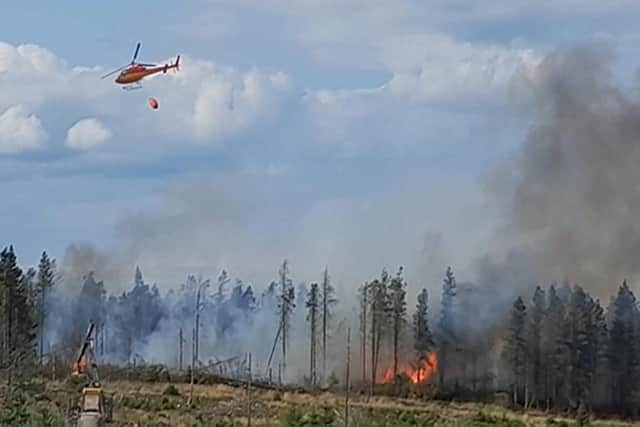

The smoke has an acrid, almost plastic-like smell, and it sits like a fog or fine mist. The small particulate in the smoke significantly reduces the air quality, which is harmful to health. I have spent far too long reading scientific papers on the impacts of smoke from wildfires. The scientific paper on the Saddleworth Moor fire concluded 4.5 million people were impacted by smoke inhalation and it even raised the expected daily mortality by 60 per cent.
Put simply, the more particulates and the longer the exposure, the greater the risk – especially for children, the elderly, and those with respiratory conditions. Not all fires are equal and fires that smoulder tend to release more particulate and thus pose a higher risk. Seeing your own child inhale that smoke brings the danger into sharp focus.
This part of the North York Moors suffered a large wildfire in 2003, the scars of this ran deep for years afterwards. In 2013 I attended a site visit where the site manager proudly proclaimed that although they did not shoot grouse, they mirrored the management techniques of the surrounding grouse moors and used all the tools available to reduce the fire fuel load, including cool prescribed burning. Sadly, times have changed and there has been a considerable shift away from using prescribed burning as the last wildfire scars began to heal.
I have written many times about prescribed burning over the years. In short it is a fast cool burn that removes the higher combustible layers of vegetation. This reduces the build-up of the fire fuel load and thus reduces the wildfire risk. Well planned best practice prescribed burns do not burn into the peat below or even the lower vegetation. Grazing, vegetation cutting and re-wetting where appropriate alongside cool prescribed burning all have their pros and cons, but each has a role to play in reducing wildfire risk.
It would be illogical to argue that prescribed burning does not release any smoke or particulate. The difference is that it can be done in short bursts during winter, with the wind carrying smoke away from nearby villages. And unlike uncontrolled wildfires, the peat beneath is not left smouldering. Fire is a natural process. Peat cores show that fire events have occurred for thousands of years. That history strengthens our duty to minimise today’s risks through managed intervention.
I am not saying that Langdale could have been saved from a wildfire if it was an active grouse moor. It is a complicated situation, especially when you factor in the RAF involvement in the area. But the fire comes at a time when the government is reviewing its consultation on further restrictions to heather burning. That process will shape how land managers reduce fire risk in future, and events like Langdale show the stakes are high.
Reducing wildfires is a goal that unites us all, from city residents and village communities to farmers, gamekeepers, and the fire service. It is time to move beyond the class politics that too often dominate this debate. Prescribed burning should be judged on its effectiveness. Simplifying the issue into ‘rich people want to burn moors so they can shoot grouse’ is a lazy stereotype that helps no one. The reality is that land managers need a full toolkit, and that includes cool prescribed burning.
Gareth Dockerty is an executive director at The British Association for Shooting and Conservation.