
What the Government needs to address when it comes to fly-tipping - Jayne Dowle
A man in Birmingham is fined £100 for dropping a strawberry stalk in a drain during the city’s bin strike. A woman in west London is fined £150 for doing the same with her coffee dregs, and a dog-owner walking her Welsh springer spaniel through Northampton town centre finds herself liberated of £100 for the audacity of forgetting to pop a ‘poo bag’ in her pocket.

It's unlawful, she learned, to take your dog for a short stroll without one. The law, however, doesn’t seem to say much about people who leave their dogs’ detritus hanging in little black bags from the branches of trees in parks and along pavements instead of putting them in a bin.
But I digress. The people involved in all of these recently-reported cases of ‘littering’ have said that when they were apprehended by local council enforcement officers, they were made to feel as if they had committed a major crime.
So where are these tough-guy ‘enforcement officers' when it comes to tackling the scourge of fly-tipping, which blights our countryside, laybys and back streets?
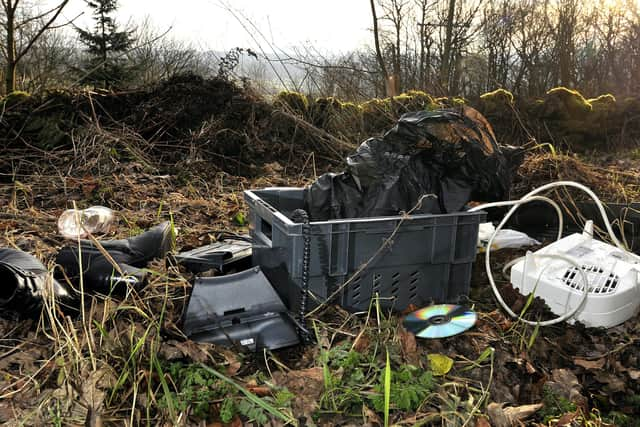

Is it the case that it’s much easier to pick on innocent members of the public who don’t even realise they’re committing an offence, than deal with the rise in criminals illegally disposing of waste and using the profits – typically taken from unsuspecting householders – to fund serious organised crime?
The cross-party House of Lords Environment and Climate Change Committee has identified fly-tipping as the “new narcotics”, and makes no bones about the involvement of organised crime groups.
Its new report highlights the proliferation of bogus waste-disposal companies which advertise their services on local Facebook groups, offering cash-in-hand collections of household rubbish, but then dump it illegally instead of taking it to a registered waste disposal facility.
Such operations, the committee found, are backed by organised criminal gangs, who then channel the money into drugs, money laundering and modern slavery.
Talk about a wake-up call to the Government; the Lords are laying it out for ministers here, yet in response, all a Defra (Department for Environment, Food and Rural Affairs) spokesperson can say is: “This Government is taking action to clean up Britain and tackle waste gangs.
“Under our Plan for Change, we are tightening the net on gangs exploiting our waste system by helping councils to crush fly-tippers’ vans, funding more Environment Agency enforcement officers and imposing tougher sentences for those who transport waste illegally.”
If the Government really was doing all those things, why is the House of Lords finding so many omissions?
The committee highlights multiple failures by the Environment Agency, and the ineffectiveness of its Joint Unit for Waste Crime, which should – it recommends – improve collaboration between bodies with responsibility for waste crime at a local level.
There should also be a single telephone number and online reporting tool for the public to report waste crime, it adds.
Plus, the committee urges ministers to set up a root and branch review of waste crime. That’s exactly what it is, a crime.
And in Yorkshire and the Humber, fly-tipping is a crime that’s on the increase, last year hitting its highest level since 2019.
Bear in mind, that’s just the cases reported. Thousands more will be falling under the radar even as you read this. Only this morning, I spotted a smashed-up kitchen on the lane where I walk my dog. I regularly see disgustingly stained mattresses here, and horrifically, bags of household rubbish, bursting with rotten food and nappy bags. And then we wonder why the rat population of the UK is believed to be at an all-time high.
Writing in The Yorkshire Post in April, the then-Environment Secretary Steve Reed said that the Government was looking to bring in new legislation that would mean criminals caught transporting and dealing with waste illegally could face custodial sentences.
Ministers wanted to change the law, so “rogue operators who take rubbish from someone’s home and then dump it on a nearby road” would face up to five years in prison.
But big question, how do these rogue operators get caught? Whilst urban locations can be blighted by fly-tipping, it’s far more likely to occur in semi-rural and rural areas where there is no CCTV and precious little presence from those authorities that stalk the streets fining people for mishandling strawberry stalks. This is a key point that the Government must address.