
Whatever happened to Sir Keir Starmer’s promise on steel tariffs? - Jayne Dowle
So President Trump has been and gone without incident, controversy or any budging on punitive steel tariffs. Such is the general sigh of relief that the US President’s historic second state visit to the UK did not come with some terrible gaffe, massive breach of protocol, mass riots on the streets or worse, the little matter of the aggressive trade war his administration has launched seems to have been overlooked.

But some of us haven’t forgotten that a few months ago, Prime Minister Sir Keir Starmer announced that our country would be benefitting from a zero tariff on steel exports from the UK to the USA.
This was heartening news for our region; the South Yorkshire economy has been hit badly by uncertainty in the steel industry.
In August the government took control of Liberty Steel's operations at Rotherham and Stocksbridge, Sheffield, after Speciality Steel UK (SSUK), was placed into compulsory liquidation due to the financial collapse of Liberty's parent company, GFG Alliance, and the failure of its main lender, Greensill Capital. Around 1,450 jobs are in the balance; no news of a future buyer for the sites is yet forthcoming.
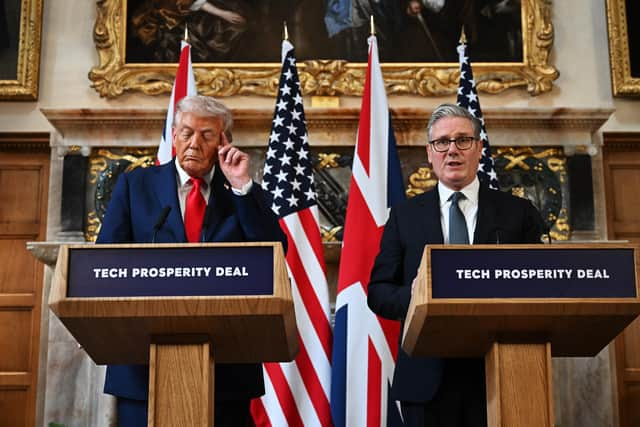

Those of us with long memories include the Shadow Business Secretary Andrew Griffith, who says: “On May 8, the Prime Minister claimed credit for negotiating steel tariffs to zero. Now it turns out that was untrue and it’s actually 25 per cent. Either his maths or his relationship with the truth clearly needs some work.”
We are reminded that we should consider ourselves fortunate; other countries, including Germany, Italy, Sweden and The Netherlands, face US steel tariffs of 50 per cent, putting the UK in a relatively competitive position.
It’s reported that our country could have sought a small tariff-free quota for its steel exports to America, but that this would leave the rest exposed to the 50 per cent US global tariff faced by other nations. You can appreciate the reluctance to engage, but still, Starmer should at least have flexed his muscles.
Also, it’s the case that in the scheme of things, exports of British steel to America are pretty small, six per cent by volume and nine per cent by value, according to BBC News.
It’s not the percentages however, but the principle of the thing. Apparently, details of Starmer’s so-called agreement with Trump were never ironed out, and now the chance for some hard in-real-life head-to-head bargaining has dissipated. The British Chambers of Commerce (BCC) is warning that the un-budged 25 per cent rate will “negatively impact” jobs in the steel industry, and are calling on the government to continue negotiations with US officials.
Who knows what might happen, but on the available evidence, there seems little appetite for this.
Whilst Starmer is no doubt relieved that Trump’s visit has passed so peacefully, his government’s refusal to get to grips with the gap does not place him in a good light.
On his way to the UK, the US President had casually remarked that he was “into helping” Britain on refining the transatlantic trade deal, which slashed trade barriers on a number of goods but failed to agree terms for steel. Starmer should have picked him up on this and pressed hard. Surely it is embarrassing for a British Prime Minister to announce one thing then seemingly fail to follow through.
The steel industry, battered as it already is, is putting on a brave face. “It will be disappointing if we do not have the tariff-free quota level, but if the US was never offering that deal, then the final decision on 25 per cent offers a degree of certainty and potentially a competitive advantage so long as other countries remain at 50 per cent”, says Gareth Stace, director-general of industry trade association UK Steel.
Given that only three weeks ago the government announced an ambitious ‘Defence Industrial Strategy’ which will invest £250m helping “working families across the country” find jobs and apprenticeships in defence-oriented engineering, including in Sheffield, where it’s intended to produce “specialist steel for gun barrels and nuclear submarines”, you might think that the British steel industry would actually be uppermost in the Prime Minister’s mind.
Apparently not so much, when faced with the tricky and unpredictable President Trump. Yet, Starmer must accept that without a stable, organised steel industry that can hold its own in international terms, our country will be in no position to manufacture the armaments and hardware we need.
Steel should not be regarded as some embarrassing Cinderella industry, but an absolutely vital cog in the wheel.