
Why women of all backgrounds are furious at Gregg Wallace’s alleged behaviour - Jayne Dowle
Talk about out of the frying pan and into the fire, every time disgraced MasterChef co-presenter Gregg Wallace opens his mouth, he seems to make matters worse.

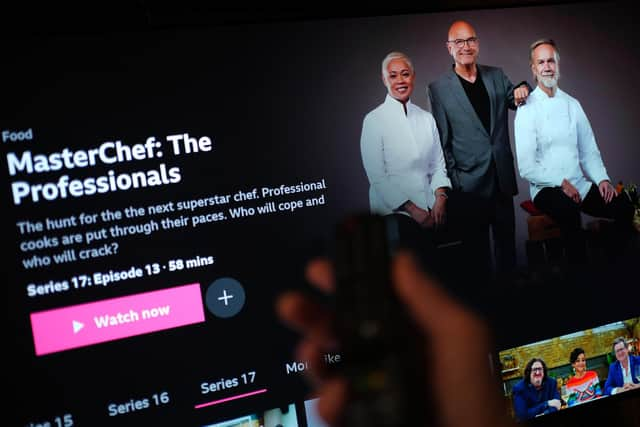
And for his erstwhile outlet, the BBC, which has opted to continue showing the latest MasterChef: The Professionals series with Wallace sharing the helm with celebrity chef John Torode, it’s the latest in a long and disturbing line of celebrities who have seemingly allowed adulation to go to their heads.
I have to admit I’m not a fan of cookery programmes, but 60-year-old Wallace is one of those minor celebs you can’t hide from. Up he pops, flaunting his ‘man of the people’ credentials and his ex-greengrocer barrow boy bonhomie, talking in tabloid newspapers about his weight loss journey (four stone, it’s reported), or waxing lyrical on his fourth wife, Anne-Marie Sterpini, 21 years his junior, whom he met on Twitter.
Until recently, he could gurn away in the background and if you looked the other way, it was quite possible to ignore the Peckham-born poser, who’s known to be over-fond of taking off his shirt. But now, that famous motor mouth has run away with him, and he’s seriously upset a demographic no-one should ever mess with, “middle-class women of a certain age”.

In an interview for BBC News last week, 69-year-old Kirsty Wark, the former Newsnight host, described how when she was a contestant on Celebrity MasterChef in 2011, she complained to Masterchef’s production company, Banijay UK, about Wallace. She considered a sexualised monologue he delivered early one morning on set (sparing the lewd details) so ill-judged that it made her angry. She was also worried that mostly female staff on short-term contracts would not feel able to object to similar crass talk.
BBC News also heard from 12 other people making allegations of a similar nature. When the story went mad, Wallace, seemingly with a tin ear and ignoring any crisis management PR advice, dismissed the complaints in a video as coming from “a handful of middle-class women of a certain age”.
Defending himself, he argued: “I have worked with over 4,000 contestants of all different ages, all different backgrounds, all walks of life”, who apparently had nothing to say in response to his antics, which reportedly include prancing about almost naked in the studio.
Wallace has since apologised for the video, has “stepped away” from the show and is cooperating with an investigation by MasterChef’s production company, Banijay UK. Through his lawyers, he has denied sexually harassing behaviour.
We could ask, in these serious times, why should anyone get in a tizz over a silly man, no spring chicken himself, who resolutely refuses to read the room? There’s another one with a tin ear in Downing Street, and surely what he does and says is of more importance to most people’s daily lives?
But the point is that Wallace is not alone. The BBC – and television in general – needs to up its game and call over-blown celebrities to heel. Wallace joins a pitiful parade of ‘stars’ mired in controversy, their names tainted.
No wonder women are angry, and not just middle class ones of a certain age. There is a huge sense of entitlement hanging over Wallace, and it needs pricking.
When I hear of cases such as his I wonder if somehow we all dreamt the #MeToo movement. Launched seven years ago, the viral campaign, rapidly adopted by actresses and performers who had found themselves at the mercy of predatory and powerful male industry figures, aimed to raise awareness and end sexual abuse, sexual harassment and rape culture.
It fizzled away during the pandemic, and even online encyclopaedia Wikipedia describes #MeToo in the past tense. I find this deeply troubling and very sad.
The only positive we can take from the Wallace debacle is that it’s reigniting the flame and prompting public debate once again.
Allegations levelled against him of inappropriate sexual banter are just the tip of the iceberg; through them we must also consider issues about power relationships, gender expectations, toxic workplace culture, the nature of fame and media manipulation.
As veteran celebrity public relations expert Mark Borkowski argues, “the crux of Wallace’s failure lies in the way he has been applying an outdated formula for fame, ignoring the cultural shifts that demand emotional intelligence and humility”.
It could well be too late for Wallace to retrace his steps, but for others out there there’s a lesson to be learned. Keep your hands to yourself and your clothes on, mind your language, and watch out for angry women, of all ages, and classes.