
Yorkshire's record levels of school absences should be treated as an emergency: Jayne Dowle
For the first September in 18 years, I won’t be waving off a child to school or college. My time of parents’ evenings, sports days and school trips is done.

But in my long experience of dealing with everything from uniform policies to cyber-bullying, I’ve always believed that the best place for kids is in the classroom.
So I was saddened to learn that unauthorised school absences across Yorkshire and the Humber are at a record high, and this is significantly impacting children’s life chances.
Our region also had the joint-highest unauthorised absence rate in England, alongside the North East, for the 2023 autumn term, according to newly released figures.
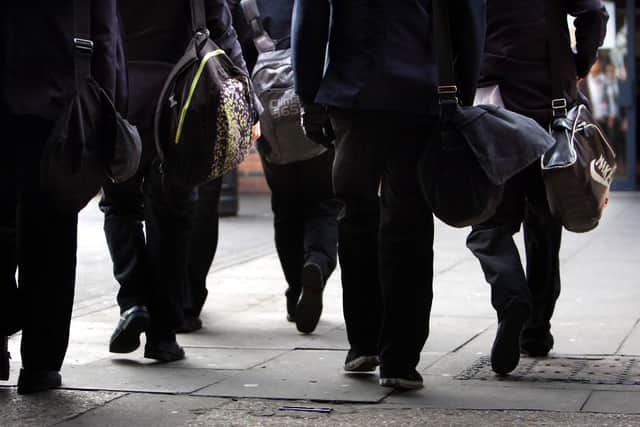

Department for Education data shows that 2.8 per cent of school sessions in Yorkshire and the Humber were missed without an authorised reason, more than double the rate from 2016, when comparable data was first collected.
Sheffield has the highest rate of unauthorised absences in our region, at 3.75 per cent, followed by Bradford, at 3.49 per cent. North Yorkshire has the lowest rate at 1.83 per cent.
Our region’s school absence rate is around 50 per cent higher than London and the East of England, yet another stark reminder of the growing North/South divide in education.
Today’s GCSE results may tell their own story; last week, we saw huge regional disparities in the achievement of top A* and A grades at A Level.
In Greater London, almost 32 per cent of all A Level passes were at A* or A, in Yorkshire and the Humber, this fell to less than 25 per cent.
My obdurate school attendance stance has been tested at times. My son hated his first few months at secondary school. I had to walk him there every morning to ensure he got through the gate in a calm enough state to start the day.
My daughter was bulled cruelly by girls she considered friends. She lost her confidence. I kept telling her she must face it, because after leaving my happy primary school, I spent almost two years, on and off, hiding at home.
I know what damage school absence can cause, that feeling of isolation, of not being understood, and how difficult it is to slot back into things when you finally do make it through the door.
The comprehensive I went to was rough. To an 11-year-old, it was full of huge teenagers who were bitchy or aggressive, often both. I was picked on for being taller than average, sneered at for showing academic promise, and dreaded that school bus.
One morning, about three weeks in, I simply decided to opt out; my parents, at their wits end, took me to doctors and specialists to find an explanation for my mysterious litany of physical complaints. There wasn’t one.
Finally, at the age of 14, I gained confidence through working a part-time job (it was legal back then) and returned, full-time, for the last few years. The damage was done however; I scraped a few O Levels (failing maths and science) and moved onto sixth form college, which shaped the rest of my life.
When parents tell me that their children are finding school impossible, I am always sympathetic, not least because there are some very harsh punishment and exclusion policies today which often discriminate against sensitive or neuro-diverse youngsters.
A Yorkshire Post investigation into the school absence crisis found that a draconian approach to tackling school attendance is forcing children to often be taught at home, in what could be considered unsuitable environments.
But the point is, once a child sees that dropping out of school is possible – and if their parents allow this to happen – their world will start to crumble.
I certainly do not have sympathy for feckless parents with a laissez-faire attitude to school attendance. Yet too often, I see it – children running around the supermarket in the middle of the day, not a spot of illness in sight, just slack adults who can’t be bothered to sort them out in time for school.
Much as I rail against seemingly pointless rules in any setting, I do accept that school teaches you to respect behaviour codes. It also teaches you to overcome adversity and to realise that sometimes life is not fair.
But most importantly, school teaches you to respect other people and to learn how to function as part of a community.
As Ilkley-based former Children’s Commissioner Anne Longfield argues in her book Young Lives, Big Ambitions dangers, including criminality, exist in the schism where young people are not able to – for whatever reason – partake in structured learning. She calls it a national emergency.
Across England, the overall school absence rate has dropped to 6.7 per cent from 7.5 per cent in autumn 2022, so this national emergency is happening in full force here, on our own doorstep.
It threatens grave consequences for the life chances of young people and has immense potential to impact on stable society and economic growth. Schools and support services must be given the resources they need to reverse the trend, and parents must stand firm and put their children before themselves.