
Andy Burnham's 'reset' deal is a bridgehead to rejoining EU: Yorkshire Post Letters

Thomas W Jefferson, Howden.
You characterise the EU reset deal as a “fig-leaf realignment….that changes little in policy terms” (The Yorkshire Post, Comment, November 21). The EU will become our rule makers in both food and energy, two sectors that fan out across the entire economy.
The alleged benefits of £17bn will supposedly accrue, not by the end of this parliament as you state, but by 2040. That claim is unravelling daily, as interested parties analyse it and some claim it could have an overall net cost.
What about the costs of compliance for the 90 per cent of businesses that don’t export to the EU and the opportunity cost of lost growth in agri-tech due to the EU’s over-regulatory mindset? There must be full disclosure of the deal’s impact and time for scrutiny before the bill presented to parliament is passed into law.
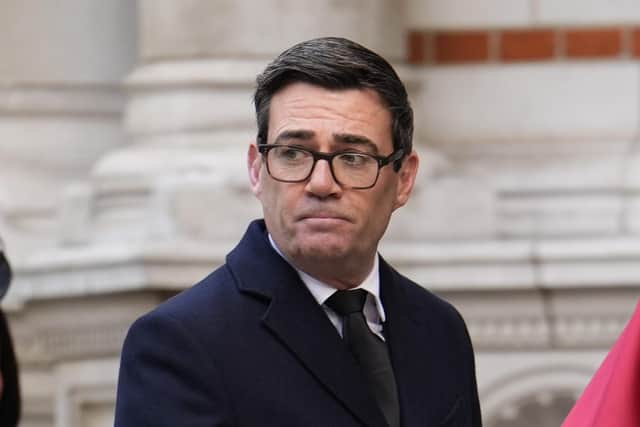

Veteran Labour MP Graham Stringer says the Prime Minister “doesn’t have a mandate to make people poorer and reduce their democratic rights”. He has a point. Burnham won his Makerfield seat by saying it was the wrong time to reopen the Brexit debate.
As the European Court of Justice’s writ stands ready to again dominate our lives, Burnham’s volte-face further erodes trust in our politicians. The real purpose of this reset is to build a bridgehead back into the EU – it is ideological, not economic.
Jas Olak, Vice Chair, Leeds for Europe, Roundhay, Leeds.
You suggested in the Comment column (The Yorkshire Post, November 21) that Andy Burnham has reached the limit of what he can do to repair European relations without a new public vote.
No doubt the Prime Minister does feel hemmed in by the red lines in the last Labour manifesto – preventing any immediate agreement on the single market, a customs union, rejoining or restoring freedom of movement in this Parliament.
I could argue no government should be obliged to stick to any manifesto commitment that has diminishing public support, is clearly not working in the country’s best interests and is failing to keep pace with global developments. There would be little point in making that argument, at least for now.
For now, Mr Burnham has clearly accepted he must wear Sir Keir Starmer’s hand-me-down electoral straitjacket. But, even within these constraints and the mandate he has inherited, there is much he can still do to improve our country’s fortunes.
Friday’s Brussels agreements are a welcome start - lifting costly paperwork off Yorkshire food exporters and freeing Sheffield steel from EU carbon levies. Next, ministers must resolve differences over EU student tuition fees within six months without undermining Yorkshire’s universities, and ensure the Youth Experience Scheme and Erasmus+ launch smoothly.
Still inside Labour’s existing manifesto, the Government should conclude talks to link into the EU electricity market to help cut energy bills, secure inclusion in the EU’s “Made in Europe” industrial plans, and deepen defence co-operation. Two overdue 2024 pledges also need urgent delivery: easing red tape for touring musicians and securing mutual recognition of professional qualifications for Britain’s services sector.
Alongside that unfinished business, Mr Burnham plans a year-long national conversation on our long-term relationship with Europe. The public must use it to make unmistakably clear what we want in the next manifesto – not least because critics of Friday’s deal keep unwittingly reminding us that having “no say, no vote, and no veto” over EU rules can only be resolved one way: full membership.
So, much still to do before it is necessary to seek that “renewed mandate”. Mr Burnham has ruled out an early general election. Yet if Reform UK’s slide in the polls continues while strong public backing for closer EU ties holds, the temptation to call one sooner rather than later must surely be there.
Stephanie Shield, Sinnington, York.
James Bovington (The Yorkshire Post, November 20) claims that we have the opportunity to claim our freedom by rejoining the EU,
Andy Burnham has now claimed a landmark by agreeing to allow European exchange for young people. I am approaching my 90th year and attended grammar school in the 1950s. Then I corresponded with a French school girl in the Loire region and the correspondence continued for several years after leaving school.
Both my penpal and myself spent a month staying with families in each other’s country where we benefitted from cultural and social opportunities and improving our language skills. Our school also employed a French lady teacher for a year when we learnt about her life and family and she helped with good French pronunciation of the language.
So Mr Bovington – what’s new? These exchanges took place before we were dragged into the EU. We have our freedom now, out of the EU. Long may it continue.