
Solar power has a place - but not on vital farmland: Yorkshire Post Letters

Christopher Shaw, Burrill, Bedale.
Earlier this month the vast majority would have been heartened to see democracy in action with the repudiation of Trumpism in the US, despite Elon Musk spending $500m of his own funds to prevent that happening.
However here in the UK there is an area where the democratic process appears to be almost completely absent.
The relentless march of solar farms across the countryside continues apace; the latest being the Overton Grange project near York, where well-farmed land will be taken out of production for over a generation, by which time the people will look back in bewilderment at this perverse way of tackling the climate crisis.
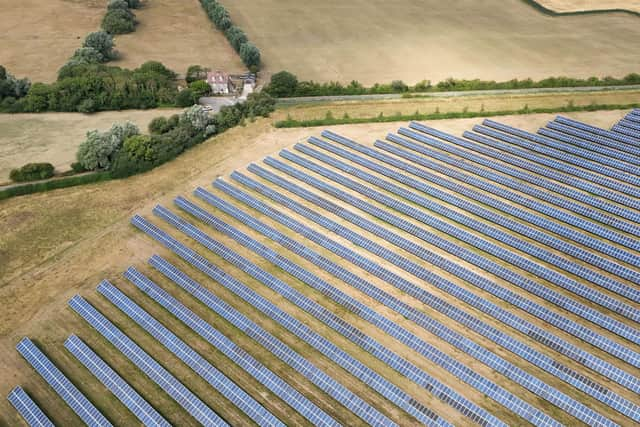

The landowners involved will be able to take more skiing holidays and afford the private school fees for their families it's true - but how will this help address a nation which only produces 40 per cent of its food requirements?
Local opposition to solar farms is always very high, but only seems to be then humoured (at the taxpayer's expense) before being approved by a compliant government. What ordinary people cannot understand is why solar farms are always sited on productive land.
Despite hiding beneath a cloak of saving the planet , the solar companies are large corporate enterprises, driven by maximising profit.
To paraphrase President Kennedy when he spoke of sending Man to the moon - "We choose to build our solar farms on good farmland in this decade because it is easy, and doing it another way would be too hard"
The Government must pause before the juggernaut of solar devours all in its path. PM Cameron had a Trumpian moment when he inexplicably halted wind farm expansion; we cannot let the messianic zeal of Ed Miliband-type thinking eclipse common sense.
There is a place for solar power, but that place is on brownfield sites, difficult terrain, rooftops; not on agricultural land where the corporate profits for the solar firms are the easiest to harvest.
Colin Jones, St Leonard, Exeter.
The government has approved the Jackdaw gas field, which many will assume makes a significant contribution to our energy needs. It doesn’t.
Even on optimistic assumptions, and assuming none of its gas is exported, Jackdaw would supply only an average of around 2 per cent of UK gas demand for about ten years. Wind power offers an alternative on a surprisingly modest scale. Around 2 GW of additional wind capacity could generate an equivalent amount of energy.
Britain already has more than 32 GW of offshore wind capacity, with over 11 GW under construction and considerable scope for further expansion.
Wind farms also typically operate for 25 to 30 years, continuing to generate electricity long after Jackdaw has run dry.
We could even reduce our need for imported gas without building more wind farms. Upgrading the electricity grid to reduce the amount of renewable energy wasted because of grid constraints could deliver greater long-term benefits than Jackdaw.
New gas fields won’t lower our energy bills, because gas prices are set by international markets. Nor will Jackdaw end our reliance on imports: it’s simply too small. Making better use of existing wind farms through grid improvements, alongside expanding wind and solar capacity, offers a more lasting way to reduce our dependence on gas.
These investments can also support more jobs and displace gas consumption for decades, rather than relying on another relatively short-lived North Sea field.