
Captain Eric Casson: Research vessels captain recalls 1990s arrival of bluefin tuna on Yorkshire Coast
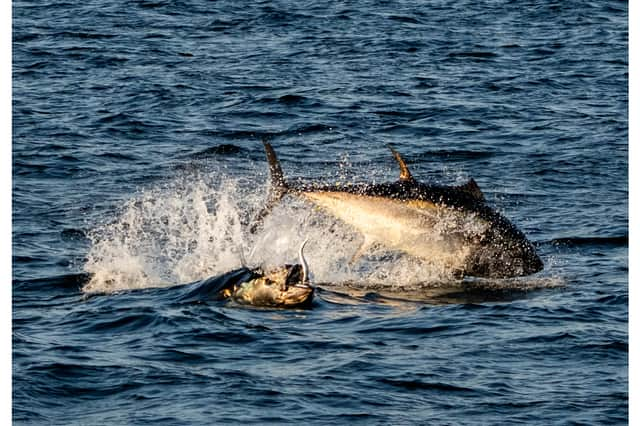
A captain of environmental research vessels has told of his first-hand experience during the 1990s witnessing the arrival of the Atlantic bluefin tuna along the Yorkshire Coast.

The Atlantic bluefin tuna have historically been spotted around the majority of the UK, including the northern coastal waters of Hull.
Due to overfishing across the Atlantic, the species - that also goes by its scientific name thunnus thynnus - decreased in numbers and gradually became non-existent.
As a result, they haven’t been sighted since the 1960s until this year.
Captain Eric Casson, 66, from Hull, who works for Humber Marine was born into a family of marine experts.


He tells of how his role in the late 1990s was a catalyst for preserving and increasing the UK’s stocks of large tuna that has been revealed in recent years.
Capt Eric was a British Seas Fishery Officer in 1999 and worked for the Scottish Office, where he was tasked to patrol the waters around Rockwall in the Atlantic.
His role was to ensure that both their national and fishery limits were being respected by foreign nationalities.
As he approached Rockwall and made visual contact with the rock, it emerged from the depths of the ocean.
After continuing to patrol the adjacent waters, he suddenly spotted a trot of fishing buoys, the end of which was marked with a satellite ID buoy with Japanese lettering.
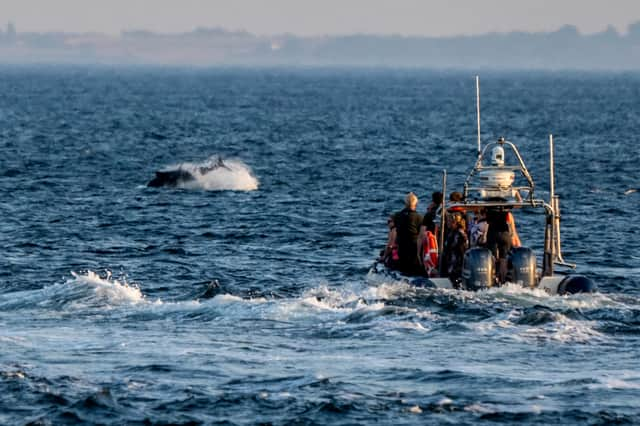
It had deployed their fast interceptor rib to inspect it and was within UK limits with no vessel in sight.
Capt Eric said: “We therefore dropped away below the horizon to wait for nightfall and remained there incognito.
“Eventually the mother ship appeared to collect the trot of long line fishing gear and its catch.
“At this juncture we mobilised our fast interceptor rib and in association with our patrol ship, through a series of coordinated manoeuvring, persuaded the Japanese vessel to heave [ashore] for an inspection by our team of fishery officers.
“Our team duly boarded the vessel and commenced the inspection of the vessel's documentation and catch.
“She was in breach of UK fishery regulations having no license to fish in UK waters as the target species was tuna.”
He entered the fish hold where the temperature was significantly below freezing and found at least two-thirds of large mature tuna.
It was “a sight to behold” given the overall significance of the catch, Captain Casson said.
The catch landed in the west of Ireland and flew to Japan, given its value and demand.
“This was a case for arrest but following due consultation at higher levels,” he said.
“It was deemed to be sufficient to caution the fishing vessel's captain and that he warn the other vessels to keep away from UK waters.
“In doing so, this singular act has helped to both preserve and increase the UK's stocks of large tuna which has become evident in recent years and therefore, can only be healthy for the marine environment and its biodiversity especially along Yorkshire's East coast.”
With temperatures rising for decades all over the world, particularly in the Pacific Ocean, as well as the consequence of higher sea temperatures, the Atlantic bluefin tuna has returned to the North Sea for the first time since the 1960s.
“The sea temperature will dictate how sustained and numerous this migration will be, and as such, could well fluctuate year by year,” Captain Casson said.
“It can only be healthy for the marine environment and its biodiversity especially along Yorkshire's East coast.
“However, they have very few predators as adult fish.”
Their main predators are killer whales (orcas) that observe occasionally by hunting and preying on large adult bluefin, pilot whales - known to target or feed alongside tuna habitats, and large open-ocean sharks - a species such as the mako shark occasionally prey on tuna.
“Those listed above should also migrate to the region following their prey in essence and certainly Orcas have been seen offshore,” Captain Casson said.
“Humans are the single largest and most impactful predator of the Atlantic bluefin tuna is commercial and industrial fishing.
“In their own right they are an apex predator to all the other fish in the sea off the East Yorkshire Coast, such as Cod, Haddock, Whiting and Salmon.
“A natural balance should thereby ensue. The only unknown is how the local fishery/fisherman both private and commercial will respond, as they are a highly prized fish and can sell for a considerable return.
“They are a prized offshore sport fisherman's fighting fish too and should thereby attract some significant interest from that sector too.
“Overall, the manifestation of the Bluefin Tuna back in East Yorkshire waters should bring greater balance and biodiversity along with social and economic benefits to local communities.”