
Remarkable Mouseman refectory table used in Parliament's secret wartime meeting place to go under hammer
A remarkable Mouseman refectory table that was part of the furniture in Parliament's secret wartime meeting place is to go under the hammer in an auction in Yorkshire.
The adzed oak table was one of the pieces commissioned from Robert 'Mouseman' Thompson's Kilburn workshop in 1937 by the internationally famous architect Sir Herbert Baker for the new Westminster Church House - headquarters of the Anglican Church - on a site next to Westminster Abbey.
Officially opened by the King in June 1940, the Church had exclusive use of its new headquarters for just a matter of weeks. Concerned that the Houses of Parliament were an obvious target for German bombers, Winston Churchill ordered that MPs should decamp to Church House.
Parliamentary sessions took place therein complete secrecy for months.

They also took place for a time after the Chamber of the House of Commons was destroyed by bombing in May 1941.
"Robert Thompson's refectory table was in the middle of all this," said auctioneers Duggleby Stephenson's Holly Hammond, "indeed it survived unscathed when the building was actually hit by a bomb that destroyed the organ."
"We can never know who sat round this piece of Yorkshire craftsmanship and what matters were discussed but given that Church House was the very centre of government in some of the darkest days of the war . . . was the location of the first meeting of the United Nations Security Council in 1945 . . . and has been the headquarters of the Anglican Church . . . it's a fair bet that the list includes some very famous names."
The table is one of the star lots in an outstanding collection of Mouseman that is going under the hammer in a 'Yorkshire Masters & Makers Auction' at the Duggleby Stephenson saleroom in York on Friday May 8 - the week of the 150th anniversary of the birth of Robert Thompson (May 7th 1876).
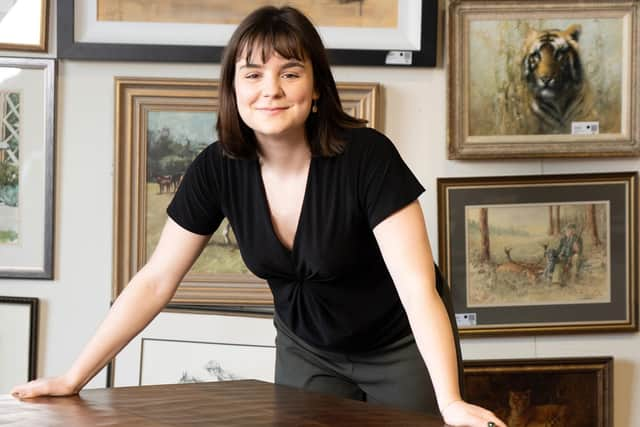
Holly added: "The table was made at a time when Robert Thompson's business was hitting one of its great peaks. The workshop team had grown to forty craftsmen and apprentices and was winning prestigious commissions from the likes of York Minster, Peterborough Cathedral, Westminster Abbey and elsewhere. It was all a long way from the hard post-WW1 years when a man that Robert was working with famously made a remark about being as poor as a church mouse - triggering the idea of the mouse trademark."
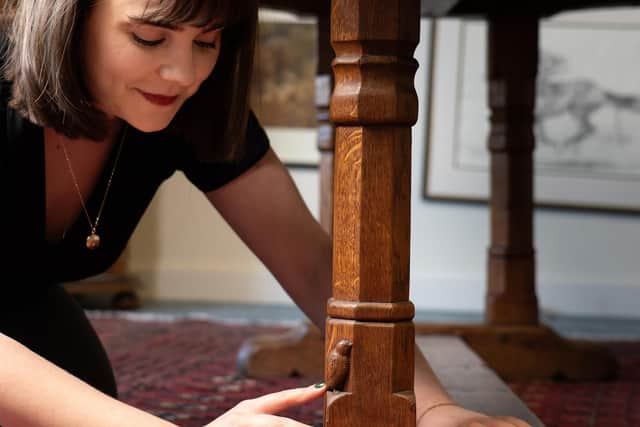
The refectory table not only has the Thompson trademark mouse but also more carvings.
Two of the legs have loaves, an allusion to the architect who gave Kilburn the business and the other two legs have partridges – a nod to the Bishop of Portsmouth, Frank Partridge who played an important part in the Church House project and was the secretary between 1936-1941.
Holly said: "The table has been entered by a vendor who has been taking an interest in Mouseman for more than forty years and began buying at a time before prices rocketed to their current levels.
"This is a very special piece, even by Mouseman standards, and it is expected to make £8,000 - £12,000."
Other highlights of the sixty-one Mouseman lots in the auction include a 1940s panelled vestibule door with a glazed section that is expected to make £8,000-£12,000 and a panelled oak front door of similar vintage that has a pre-sale estimate of £7,000-£10,000.
Meanwhile an early piece, a burr oak stool made in 1927 is predicted to go for £1,000-£2,000 and a pair of bookends that each bear three carved mice.
The bookends piece is is predicted to hit £2,000-£3,000.
The catalogue for the Yorkshire Masters & Makers Sale, the inaugural auction designed to celebrate the work of the county's great artists and craftsmen, is available at www.davidduggleby.com.
Viewing is at the Duggleby Stephenson Saleroom in the York Auction Centre at Murton throughout the week including Friday May 8 from 9am until the start of the auction at 2pm.