
Fire chiefs warn zero-hour contracts ban would ‘undermine’ emergency response
The NHS and fire and rescue services are calling for carve outs from Angela Rayner’s Employment Rights Act.

Fire and rescue services have warned that Labour’s new law banning zero-hour contracts will make it hard to employ emergency cover to help tackle major incidents.
Angela Rayner’s Employment Rights Act means that employers will have to pay workers for a guaranteed number of hours.
The Housing Secretary has said this will end “exploitative” zero-hour contracts.
However, this has felt the heat from fire service chiefs, who have said it will make it much harder to get in emergency cover.
Almost one in three firefighters are on zero-hour contracts, where they respond to emergency call-outs alongside their other job.
They are used to tackle major incidents, such as the Langdale Moor fire in North Yorkshire, the largest wildfire in the country in 2025.
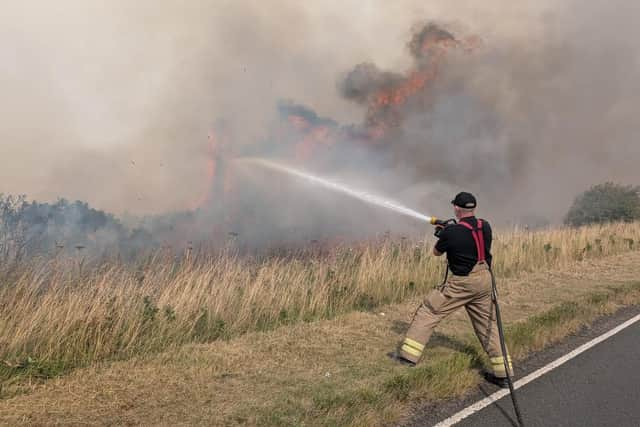

The rescue effort of fire crews, farmers and gamekeepers was beset by explosions from World War Two munitions, as it reached RAF Fylingdales which was built on an old army training area.
After six weeks, the blaze was eventually put out, but not before it had surged towards properties and businesses.
This relied on the help of volunteers and emergency firefighters called into action.
A spokesperson for the National Fire Chiefs’ Council said: “We fully support the principle that people should be treated fairly at work and have appropriate security and certainty in their employment.
“However, the on-call firefighter model is fundamentally different from the type of insecure employment these reforms are intended to address.
“On-call firefighters make an extraordinary commitment to their communities, providing emergency cover alongside their primary employment and family responsibilities.
“That flexibility is what enables fire and rescue services to maintain cover across large parts of the country, particularly in rural communities.
“Our concern is that, without an appropriate exemption for on-call firefighters, well-intended reforms could have the unintended consequence of making an already fragile system harder to sustain.

“That could affect recruitment and retention, reduce the availability of fire appliances and ultimately weaken the resilience of the communities we serve.
“We want to continue working constructively with the government to ensure the legislation delivers greater security for workers without inadvertently undermining a vital part of the UK’s emergency response capability.”
He explained: “It is not an efficient way to use public money to run an emergency service and will put the service and the protection of the public at risk.”Mr Cowan added that fire and rescue services would either have to retain firefighters when they were not needed, or risk not having cover in an emergency.
Fire services are calling for a carve out before the changes get put into practice next year.
The NHS is also asking for special dispensation to ensure it can rapidly hire doctors, nurses and midwives to cover sickness, seasonal pressures and major incidents.
The NHS Alliance, which represents trusts, said the changes would have “significant unintended consequences”.
Sir Ciarán Devane, chief executive of the NHS Alliance, said: “While this initiative by the government is for good reason, current proposals risk landing the NHS with another unfunded cost at a time when cuts have already had to be made to budgets.
“Patient care will be at genuine risk if fewer staff come forward to fill shifts and if more have to be diverted from other responsibilities to do the admin associated with these changes.
“We cannot afford to take on more cost when the NHS is not the problem.”
Ben Morrin, boss of NHS Employers, added: “The government’s current proposals do not adequately reflect the operational realities of delivering healthcare services 24 hours a day, seven days a week.
“Flexible staffing arrangements play a vital role in maintaining safe care, responding to fluctuating demand and reducing reliance on more expensive agency workers.”
A government spokesperson said: “We are committed to tackling the one-sided flexibility that can result from zero-hours and similar contracts, when workers bear all the financial risk of uncertain hours, shifts and earnings.
“We’re grateful for the many responses we received to our consultation. We are taking them fully into account and working to get the detail right so that the new rights work in the real world — including for the NHS and other public services.”