
Government sets 50% domestic steel target and announces tariffs in landmark strategy
Half of all of the steel used in Britain will be produced domestically, the Government has said, outlining its ambitions to save the under-pressure industry with its landmark steel strategy.

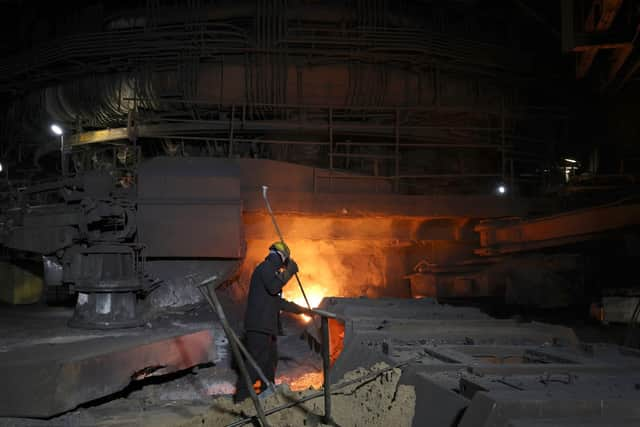
Business and Trade Secretary Peter Kyle will make the announcement at the Port Talbot steelworks, in South Wales, today and outline the ambition to boost domestic production so it can meet 50 per cent of the UK demand.
The Government is also set to impose strict quotas on foreign imports, increasing this by 60 per cent, from July 1.
Any steel coming into the UK above this level will be subject to a new 50 per cent tariff.
Mr Kyle said: “Making steel in the UK is vital for national security, critical infrastructure and the wider economy.
“Steel-making is a cornerstone of our modern industrial policy that deliberately focuses support for key industries, technologies, and strategically important sectors.

“With this strategy we are closing the decades-long chapter of destructive de-industrialisation and committing instead to strengthening and sustaining Britain as a steel-making nation.”
The Government said it will boost domestic production by providing £2.5bn of financing for investment in the steel sector through the National Wealth Fund.
The Department of Business and Trade also confirmed it sees electric arc furnaces (EAFs) as the future of steel. The strategy comes at an uncertain time for the industry.
The Government was forced to step in and take control of the Scunthorpe plant last summer, after it emerged that Chinese owner Jingye was winding down the blast furnaces.
If they had gone offline then they would have become almost impossible to restart, leaving the UK as the only G7 country unable to produce virgin steel.
Jingye had wanted to shut down the blast furnaces while transitioning to EAFs, despite the Government’s £500m funding offer to keep them online.
At the same time, the steel industry has been hit by tariffs in the US and the prospect of additional tariffs in the European Union, where the vast majority of UK-produced steel is exported to.
Unions said the strategy has “demonstrated the Government’s unyielding commitment to protecting the sector and the thousands of jobs it provides in communities across the country”.
Roy Rickhuss, the general secretary of the Community Union which represents Scunthorpe steelworkers, said: “The trade measures outlined in this strategy represent a bold and significant step forward, strengthening our domestic industry and helping to ensure that local economies continue to benefit from a secure, resilient steel sector and the employment it provides.”
Gareth Stace, director general at the trade body UK Steel, added: “The Government’s bravery in taking the required measures represents a real shift in the culture of Westminster from protecting the ideology of free trade at any cost, to defending critical industries and national security.
“Steel underpins our national security, our energy transition, and the delivery of critical infrastructure. Yet for too long, the UK has lacked a coherent, long‑term plan to support the sector.
“Today’s strategy acknowledges the essential role steel plays in every part of the economy and sets out the direction needed to attract investment, boost innovation, and strengthen our industrial foundations.
“This is a crucial moment: with global markets distorted by overcapacity and subsidy, a clear and ambitious domestic strategy is exactly what is required to ensure steelmaking not only survives in the UK but thrives.”
This was published on the same day as the second part of Rachel Reeves’ Northern Growth Strategy.
The announcement includes £50m for a South Yorkshire Defence Growth Deal, that the Treasury says will boost the burgeoning research and development sector in the region.
Mayor Oliver Coppard said this was a “huge vote of confidence in the work we do here in South Yorkshire and our contribution to the security of this country”.
Ms Reeves said the Government’s Office for Investment will also help attract more global companies to Leeds’ Northern Square Mile, making the most of the city's fintech expertise.
The Chancellor commented: “For too long the North has been sidelined, denied investment and had its potential held back.
“Backing its industrial strengths like Manchester’s thriving digital sector and Sheffield’s cutting-edge defence manufacturing will boost the region’s economy and place it at the centre of our national growth.
“In a changing world we have the right economic plan: stability, investment and reform to build a stronger, more secure economy.”
However, once again, the Chancellor appears to have focused on the cross-Pennine corridor of big cities, apparently excluding places like York, Hull and Teesside.