
‘Intentional’ unauthorised development approved in Yorkshire Dales

Unauthorised building work at a Yorkshire Dales property has finally been approved despite planning officers acknowledging the development appeared to have been carried out deliberately without permission.
Members of the Yorkshire Dales National Park Authority’s planning committee granted retrospective permission for extensive alterations at Far End House, near Austwick, after previously delaying a decision amid fears that approval would encourage others to ignore planning rules.
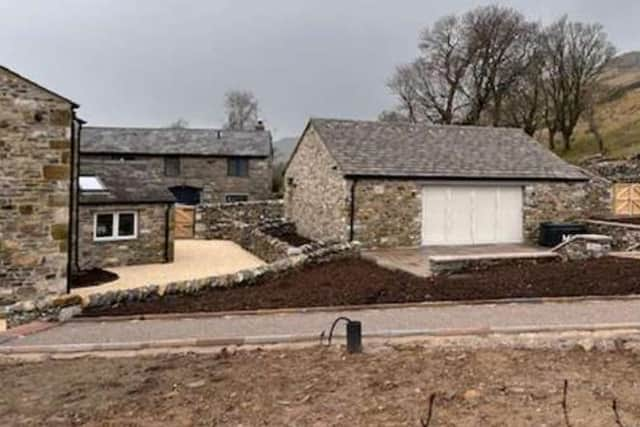
The development includes the demolition and substantial rebuilding of a former agricultural outbuilding, the extension of a garden into farmland and the installation of ground-mounted solar panels.
In a report to councillors, officers acknowledged the scale of the unauthorised work made it difficult to conclude it had not been carried out intentionally.

Under national planning policy, intentional unauthorised development must be given substantial weight when deciding whether retrospective permission should be granted.
However, officers said the applicants, Mr and Mrs J and R Henson, had demonstrated a willingness to put matters right and had agreed to further changes following concerns raised by councillors and Austwick Parish Council.
These include removing unauthorised metal fencing and reinstating a traditional drystone wall, as well as additional tree planting to compensate for trees previously removed.
The applicants have also sought funding from the Yorkshire Dales Millennium Trust to plant 125 native trees to create a small woodland and provide further planting on their land.
At the latest meeting, committee member Allen Kirkbride welcomed the progress made.
He said: “It seems to have been a long saga, this application. We’ve had it, I think, two or three times before us.
“And I think now, thanks to the officer and the applicant working together, we’ve got somewhere near where we want to be.”
Fellow committee member Richard Foster said the site had already changed considerably since councillors first saw photographs of the unauthorised development.
He said: “I remember the first set of photographs that came from this, and it’s already changed a lot.
“There’s a bit more change to do, but it would be easier if people worked with one committee first and the planning officers rather than afterwards.”
During the debate, officers admitted they would have sought a different outcome had the applicants applied for permission before demolishing and rebuilding the outbuilding.
The authority’s head of development management, Richard Graham, said the original approach would have been to retain and convert the former agricultural building rather than replace it.
“We would have sought retention of the outbuilding, and depending on what needs to be done to it to convert it to new use, to make sure that was appropriately designed,” he said.
“In this situation, there’s a certain amount of fait accompli that we’ve got to take into account.”
Mr Graham said officers had instead assessed the replacement building as it now stood and concluded that it was acceptable.
“We do need to look at the outbuilding as it’s constructed at the moment, as it’s essentially a new build,” he said.
“Would we grant planning permission for this or not? Is it harmful in the way that it’s proposed or the way it’s built at the moment?
“And we’ve taken a pragmatic approach to that and decided to recommend approval.”
The committee had deferred the application in October after raising concerns about the size of the replacement building, the removal of trees, metal fencing and whether the development could have been carried out under permitted development rights.
The latest report confirmed the former barn had been demolished and substantially rebuilt as a larger structure.
Officers stated it could not reasonably be regarded as a conversion of a traditional agricultural building and did not benefit from permitted development rights.
However, they said the replacement stone building, with its slate roof, was appropriately designed, remained smaller than the main farmhouse and would be restricted to use as accommodation ancillary to the property.
The report also acknowledged that unauthorised landscaping had significantly altered the agricultural character of the adjoining paddock.
The applicants have agreed to remove paths, steps and seating areas, regrade the land and restore its agricultural appearance.
At the previous meeting, Austwick Parish Council chairman Peter Goold had urged members to reject the application, warning that approval would set a dangerous precedent.
“If approved, the message to every applicant in the park is simple — don’t apply, demolish, build, and then re-label,” he said.
Coun Yvonne Peacock had also questioned whether the authority could effectively enforce its planning rules if such developments were subsequently approved.
Despite those earlier concerns, officers said the applicants’ cooperation and proposed restoration measures were sufficient to justify granting permission.