
Sir Keir Starmer meets Donald Trump at G7 after 'hugely significant' Iran war 'breakthrough'
US President Donald Trump said the peace agreement meant “oil will flow” freely once again through the Strait of Hormuz, the vital shipping route out of the Persian Gulf.

Sir Keir Starmer has welcomed a “hugely significant moment” in the conflict in the Middle East, after the “breakthrough” deal between the US and Iran was announced.
US President Donald Trump said the agreement meant “oil will flow” freely once again through the Strait of Hormuz, the vital shipping route out of the Persian Gulf.
The Prime Minister welcomed news of a deal at a press conference in No 10 Downing Street yesterday morning, before jetting off to the G7 in France.
Sir Keir told reporters: “I want first to welcome the breakthrough reached last night between the US and Iran, and I congratulate President Trump, the mediators from Pakistan and Qatar, and all those involved.
“This is a hugely significant moment.
“We have long called for de-escalation, and it is vital that all parties seize this opportunity to secure stability in the region and restore freedom of navigation in the Strait of Hormuz, which in turn will ease the economic pressures felt by people here in the United Kingdom and around the world
“We will now work closely with our partners to support this agreement and to ensure it turns into a durable, lasting peace.”
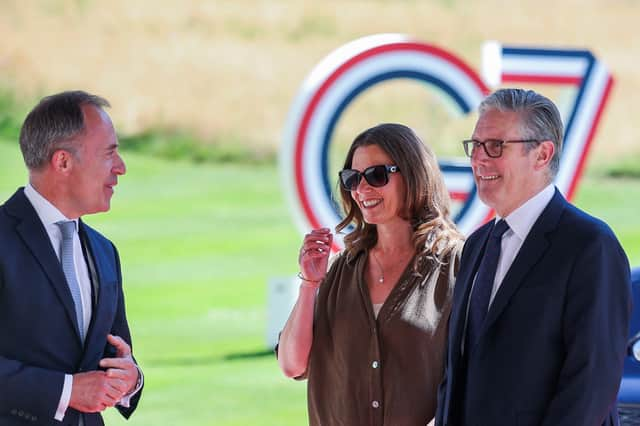

Sir Keir met Mr Trump yesterday evening as world leaders arrived at the G7 summit in Evian-les-Bains, France.
The agreement to end the Iran war has likely changed the dynamic at the talks taking place in the Alpine spa town until tomorrow.
The deal would bring to an end a four-month war in which Tehran has used a blockade of the Strait as an economic weapon, leading to fuel shortages in some countries, disruption to agricultural fertiliser supplies, and price spikes at Britain’s petrol forecourts and airports.

Oil prices fell sharply after the announcement of a peace deal, with Brent Crude, the global benchmark, dropping more than 5 per cent yesterday to just over 82 US dollars a barrel, marking its lowest level for over three months.
Stock markets also jumped higher in Europe and Asia as investors breathed a sigh of relief.
Mr Trump was celebrating his 80th birthday at a sports event at the White House when he confirmed a peace deal had been agreed.
Just days ago, when the Iran-US ceasefire was hanging by a thread amid resumed strikes, the gathering on the shores of Lake Geneva, Europe’s largest Alpine lake, appeared to be heading for stormy waters.
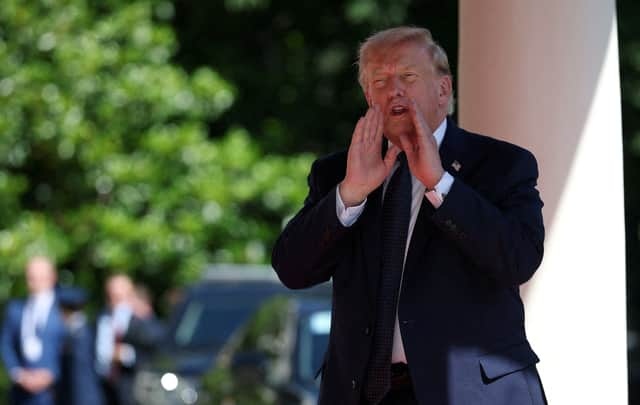
Analysts speculated that tempers could flare and that Mr Trump might not hang around for long in an Alpine spa town that has been enveloped in a security bubble for the G7 leaders and other guests invited by the event’s host, French president Emmanuel Macron.
Mr Trump’s relationships with European allies have been fraught even before he launched the Iran war with Israel in February without consulting them. This week’s gathering is the first meeting then.
As well as Sir Keir, Mr Trump and Mr Macron, leaders from Canada, Germany, Italy and Japan engaged in a working dinner last night.
Today, they are set to discuss Ukraine and defence plans, something with which Mr Trump has been piling pressure on about.
Guest president Volodymyr Zelensky will try to showcase progress that Ukrainian forces are making against the Russian invasion.
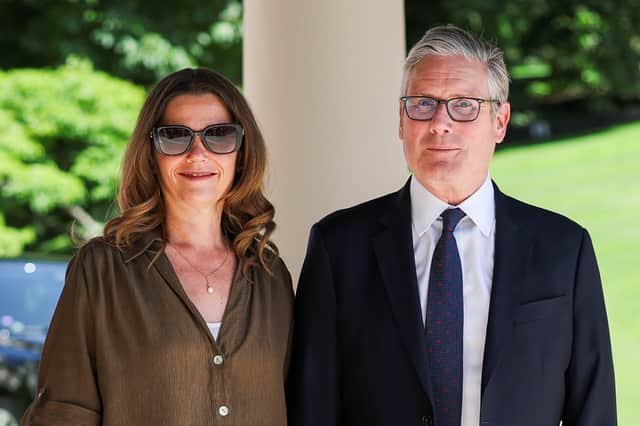
He will be hoping to convince Mr Trump that Russian president Vladimir Putin cannot achieve his aims in the war militarily, which might persuade him that Mr Putin should be pushed to the negotiating table.
After his Oval Office thrashing by Mr Trump and vice president JD Vance last year, Mr Zelensky now has “a significantly stronger hand”, said Maria Snegovaya, a Russia expert at the Centre for Strategic and International Studies.
The Trump administration “does tend to look more favourably at those states that have certain positions of power tilting in their favour”, she said.
Meanwhile, over lunch, Sir Keir and Mr Macron are expected to put forward their plan to help reopen the Strait of Hormuz.
Before jetting out, the Prime Minister signalled that Britain and its allies are ready to help protect the vital shipping lane from future shocks.
He told reporters: “You will know that we took preparatory action as a coalition of countries, led by myself and President Macron, to put together those countries that are prepared to do some of the reassurance work that’s needed when we get to a moment like this to help get vessels through the Strait of Hormuz.
“We’ve got military planning behind that, so I hope now we can play our part in relation to that.”
The discussions are expected to focus on escorting tankers and ridding the waterway of mines.