
Why Yorkshire drivers wait over a week for car parts from Europe


Have you ever ordered brake pads with a 3-day delivery period and still been waiting a week later? Then you aren’t alone.
According to many courier estimates, standard transit times from Europe to the UK typically range from 3 to 5 working days depending on the place of origin – and that's before customs clearance even begins.
For Yorkshire drivers ordering parts from continental Europe, the wait often stretches well beyond what online checkout pages promise. Understanding why requires looking at the full journey your car parts actually take.
Breaking down the real delivery timeline
Here's what actually happens when you click 'buy now' for that oil filter or clutch kit. An estimated shipping time of 3 to 5 days sounds reasonable, until you factor in what's not included: customs processing adds extra time thanks to Brexit. What about oversized parts that aren’t sorted automatically? That can take longer still, according to DHL data.
The reality is that the transit time is only one piece of the puzzle. Customs clearance, rural delivery routes, and courier handoffs all stretch the timeline beyond those initial few days. Suddenly that week-plus wait makes sense.
Winter months compound the problem. Snow in the Pennines doesn't just make your morning commute miserable, but it also stalls delivery vans trying to reach remote addresses. Peak periods around Christmas and January extend every stage of the supply chain.
What customers actually experience with delivery speeds
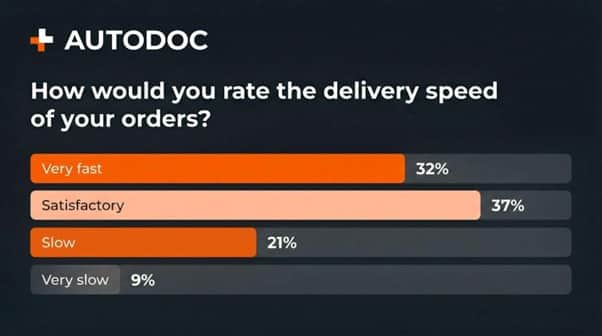
The numbers tell a mixed story. When AUTODOC recently polled their Instagram followers about the speed of deliveries, 32% rated their order deliveries as "very fast" while 37% found the delivery speed "satisfactory", meaning that roughly two-thirds of customers get their parts without major complaints. However, 21% rated the delivery speed as "slow" and another 9% as "very slow." That means one in three customers experienced frustration due to wait times.
This corresponds with the feedback on Trustpilot. Take Iain Gillespie from Yorkshire, who left a review in January 2026. He praised AUTODOC's competitive pricing and quality parts for his RAV4 but noted that his package "was delayed at three different steps” of the shipping process. His verdict: the issue wasn't the retailer, it was the courier network.
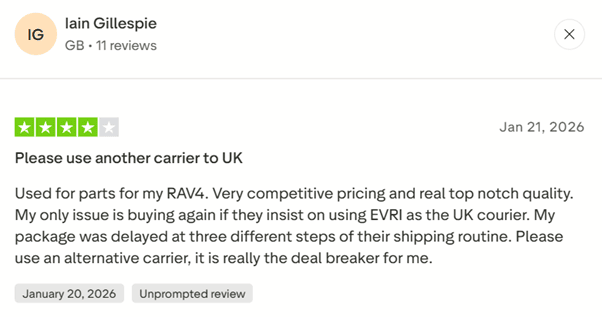
This pattern appears repeatedly across the thousands of AUTODOC UK Trustpilot reviews, where it maintains a rating of 4.3 out of 5 stars. Customers consistently praise the retailer’s quick order processing and part quality, then criticise the final delivery stage handled by third-party carriers.
Each handoff between sorting centres creates another opportunity for delays. Your parts might leave a warehouse promptly but then sit in a Midlands depot waiting for the next northbound lorry. That's the reality of last-mile logistics, especially to addresses outside major urban centres.
Why some suppliers are getting faster
Smarter operators are rethinking their warehouse strategies. AUTODOC, one of Europe's largest online parts retailers, opened a state-of-the-art facility in Ghent, Belgium in 2025. They now run four major warehouses in Berlin, Szczecin, Cheb, and Ghent. However, it’s the Ghent location that matters most for British customers.
Why? It's strategically positioned to minimise the distance to UK ports and reduce the number of handover points that cause delays. Shipping from Belgium to the UK is generally faster than transporting parts from central or eastern Europe. Each transfer point eliminated means one less place where your clutch kit could get stuck.
This multi-warehouse approach isn't unique to one company; it's becoming standard practice among serious players. Stock popular parts at multiple locations, ship from whichever sits closest to the customer, reduce dependence on any single route. It's logistics 101, but Brexit made it more critical.
Planning around the delays that aren't going anywhere
Stop trusting the overly optimistic delivery estimates. Work backwards from when you actually need the part, adding extra time for typical delays and customs processing. It is best to order essential supplies in spring or summer when the weather cooperates as winter deliveries run noticeably slower.
Check where your supplier's warehouses are based before ordering. Western European locations (Belgium, Netherlands, western Germany) mean shorter routes than parts shipped from Poland or Czech Republic. Look at the Trustpilot reviews and other independent sites, but look past the rating and focus on specific comments about delivery times to your specific region.
Consider collection points in larger towns if you're based in the sticks. Picking up a parcel from a York or Harrogate shop might be faster than waiting for a courier to navigate country lanes.
The truth is simple: European logistics after Brexit takes time, customs processes may take days, and poor weather conditions only worsen the situation. On the bright side, understanding exactly where delays actually happen lets you plan around them, which beats waiting around at home with a half-finished repair, waiting for parts that should have arrived yesterday.
To help Yorkshire Post readers plan the maintenance of their vehicles, AUTODOC has provided our readership with a discount code. Use code ATDKRS8 at the checkout for 5% off spare parts. The offer is valid until 31 March 2026.