
Travel review: Top Withens and Brontë landmarks in Haworth say more than Emerald Fennell's film could
Sam Shakerley Reed spends a winter’s day in snowy Brontë Country after the release of Emerald Fennell’s ‘Wuthering Heights’.
“Wuthering Heights” opened in cinemas in February, once again propelling the beauty of Yorkshire’s moors into the global spotlight. Having resolved to explore more of God's Own Country this year, and eager to see the landscapes that inspired the story before the film, there seemed no better time to visit Brontë country.
On a cold winter’s morning, sufficiently hat-and-scarfed up, I took a train to Keighley before jumping on a BrontëBus for the short trip through the snow-covered fields of Worth Valley to Haworth - the home of the Brontë family, and the jewel in Yorkshire’s literary crown.
By mid-morning the town’s famed steep, cobbled street was beginning to stir. Margot Robbie and Jacob Elordi featured in some form in the various boutique, antique, and book shop windows that adorn both sides.

At the top of the hill stands the church, rebuilt since the days when Patrick, the Brontës’ father, presided over the parish. A few steps further, past the most gothic-looking graveyard you’ve ever seen, and you arrive at the Brontë Parsonage Museum - the first stop of my visit.
Visitors to the Parsonage can explore the rooms in which the sisters lived, wrote, and died. These rooms have been transformed into a rich repository, offering the opportunity to learn the family’s history, and peruse various manuscripts and personal effects once owned by the sisters.
Upon arrival there was only one topic on the lips of my fellow visitors, which made me consider the film’s potential impact on local tourism.
Sue Newby, Learning Officer at the Parsonage, explained: “We always notice an upturn in visitors when there is a new adaptation on film or TV. The Brontë sisters’ own story is fascinating and there is a real appeal for people in seeing where the sisters grew up and produced their work.
“We are expecting a sizeable and sustained increase in visitors to the Parsonage and the surrounding area.”
Sue also identified a particularly popular Brontë-inspired location nearby: “There is a ruin of a farm known as Top Withens, approximately three and a half miles from Haworth, which anecdotally, is said to have been the inspiration of the house of Wuthering Heights.
“The site itself is a beautiful spot, and is very evocative of the story.”
Exploring Brontë country was certainly on the day's agenda, but not before a brew. Walking back into town I stumbled upon the Haworth Old Post Office. You won’t be able to post your Brontë-themed postcards here, but they do offer a full menu including award-winning brunch, a licensed bar, and great coffee.
The site was a post office when the Brontë sisters were working on their novels, and offers a small glimpse into their world. It is said to have been the location from which the sisters posted their manuscripts to prospective publishers, and Brontë brother, Branwell, even used to crash there after a heavy night of drinking at the nearby Black Bull.
Sufficiently caffeinated, and with the snow having just stopped outside, I swapped my desert boots for walking boots and made for the moors, following the road for about half an hour, before switching onto farmers' tracks.
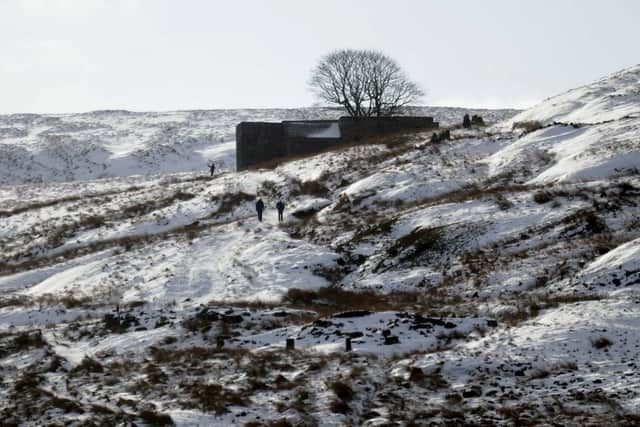
The track climbs steadily before dropping onto a narrow valley path. It is on this path, just prior to the descent to Brontë Falls, that you catch your first glimpse of Top Withens looming in the distance. Now the inspiration becomes tangible.
The path unfurls at the foot of the falls, named in honour of the sisters’ fondness for the cascade.
The accompanying bridge makes for a picturesque scene, but the icy chill lingering in the air discouraged any prolonged admiration. I nabbed a photo or two and pressed on back out of the valley.
Climbing higher, the crunch of fresh snow replaced the squelch of mud underfoot. Until this point Top Withens had remained firmly in the background, seemingly unmoved, refusing to draw nearer despite my efforts.
I dipped below and resurfaced above a snowy undulation, and all at once the summit closed in on me.
From a frozen bench I gazed out over the snow-topped trees and white-capped fields - that desolate white expanse in all its haunting grandeur. It is this duality that shapes Wuthering Heights, as Sue Newby said: “The surrounding moorland landscape plays a part in all the Brontë novels, but in Wuthering Heights the whole of the story takes place there.
“Though there aren’t lengthy descriptions of the landscape in the novel, the mixture of its beauty and bleakness is at the very heart of the story.
“It’s very clear that the three sisters had a close sense of connection with the surrounding countryside but Emily especially loved it and knew it intimately.”
Re-reading passages of the novel in the days following my trek - having traced the steps of the Brontës, felt the ooze of the moorland mud beneath my boots and experienced the icy blast of the Yorkshire wind whipping up from the gorse - I understood this entirely. The moors cast new light on the stark, elemental forces that shape Brontë’s characters. It is a must-do pilgrimage for any Brontë enthusiast.
Hike completed and safely back in Haworth, there was only one place I was going for a pre-cinema tipple. The Black Bull makes the corner where the cobbled Main Street branches up towards the church and the Parsonage. Often frequented by Branwell, if his night didn’t end hiding in the post office he was known to escape out of the kitchen window when someone came to fetch him for overindulging.
Nowadays, it offers food as well as a wide range of beers, ciders, and ales. I grabbed a quick pint of Timothy Taylor’s Boltmaker, brewed only a few miles away, before jumping back on the BrontëBus to Keighley.
Settling into my seat at the Keighley Picture House, surrounded by the creaking charm of an independent cinema seemingly unchanged since opening in 1913, I was curious to see how the film would bring the moors of the novel to life - a landscape I now felt I understood a little better.
There seems to be a mixed response to Emerald Fennell’s “adaptation”. For what it’s worth, I am firmly on the side of The Guardian’s Peter Bradshaw, whose two-star rating describes the film as “emotionally hollow”.
Some of the landscape shots were incredible, filmed 25 miles from Haworth in Swaledale, but with the exhilaration of the hike and its connection to the story still firmly in my mind, I couldn’t help but ask: what has this film added that the moors have not already said?
Between the Parsonage, the cobbles of Haworth, and the icy summit at Top Withins, I had experienced Wuthering Heights in its true setting. The film had offered colour and spectacle, but the windswept moors gave something deeper: the story’s wild heartbeat - alive in snow and solitude.
In the end, the landscape writes Wuthering Heights more faithfully than any adaptation ever could.