
David Balfe on Late Transmissions: 'We discovered what we call tragic-romantic'

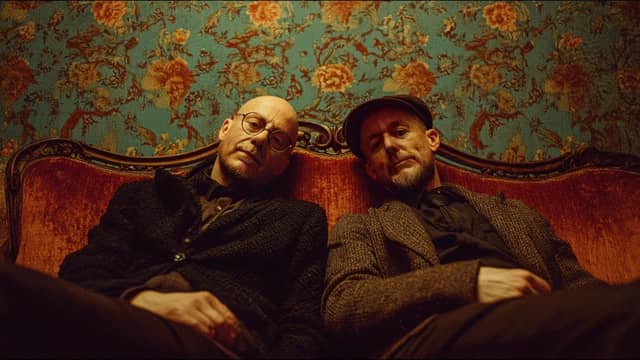

Much water has flowed under the bridge since David Balfe and David Hughes last worked together in 1978, in the Wirral synth-pop band Dalek I Love You. But now the pair have reunited in the new musical collaboration Late Transmissions.
“We’re all getting very old,” notes Balfe as he recalls that “the very first date” that Hughes had with the girl who would later become his wife of more than four decades “was bringing her with him to a rehearsal at my mum and dad’s house for Dalek I Love You”.
The band, who were contemporaries of Orchestral Manoeuvres in the Dark, was short-lived – Balfe soon departed to found Zoo Records in Liverpool and manage The Teardrop Explodes and Echo and the Bunnymen, while Hughes would go on to forge a highly successful career composing music for films and television – yet the pair remained friends and after the Covid pandemic when they both had more time on their hands, Balfe “hit” Hughes with an idea.
“I’ve always had a massive love for orchestral pop that kind of got wiped out by The Beatles – the kind of stuff like Dusty Springfield, Scott Walker and the Walker Brothers, John Barry and the Shirley Bassey things he did, and I love Burt Bacharach, stuff that isn’t just electric guitars or synths and drums – and (David) had been off doing soundtracks stuff, he was even been in Hollywood for a year or so, I’d visited his studio a few times and I’d seen all the gadgets he has for knocking up an orchestra in his little studio, so I said why don’t we try doing some of that,” Balfe explains.
“So we bounced things back and forth for years, just as a kind of fun hobby, developing these songs and then we thought we’d better find a singer.”
Enter Liverpool chanteuse Eve Quartermain (real name Joanna Brown). “She was a friend of a friend of Dave’s,” says Balfe. “She’s nowhere near as old as us but she’d been knocking around for a while trying to get going. She went down to London in, I think, the noughties and ended up in New York. When you are a singer you find producers and she had lots of them saying, ‘Come and work with me’, but it never quite happened for her. Then she ended up back in Liverpool having to get a proper job.”
Given Hughes’ skills as an orchestrator, he was well equipped for this project. “He’s far more talented than me,” says Balfe, who played keyboards in The Teardrop Explodes before becoming a music publisher and record company executive, signing artists such as Blur and Jesus Jones to Food, the label he ran in the 1990s with Andy Ross.
“(Dave and I) work really well together because we slot into different roles,” he adds. “People have an idea that making music is a very simple thing – you strum your guitar or you bang it out on a piano and five minutes later you’ve got a song. It does occasionally happen but more often it’s a weird agglomeration of ideas that get fiddled around with and put together with other ideas, then taken apart and put back together again, put on the shelf and then often months later (saying) I had a new idea to make that work. I became much better at that side of things. Dave would start off with a bit of music and I’d go, that could be a chorus. I ended up writing all the lyrics and then just sculpting the songs, saying what works where and changing a few melodies, and it evolved and developed.”

Quartermain’s tragedienne “vibe” brought a new dimension to their work, Balfe feels. “We then crafted her personality, her life story, her character into it. Just through chatting to her, we’d throw in ideas,” he says. “It would be too strong to say it’s a concept album, but when somebody was writing up the blurb that goes with it, it suddenly evolved into one if you do start taking one person’s personality and make it the core of it.
“We discovered what we call ‘tragic-romantic’ – you want love to happen but it just goes wrong all the time. Judy Garland had that vibe and you could even say Adele had that vibe – and that became the (narrative of) way love goes wrong more than the way love goes right.”
To amplify the theme of the album The Heart Wants What It Wants, the band have created a series of videos with the help of AI. “We thought the music wanted to be cinematic – that’s what I like about John Barry, Scott Walker, Burt Bacharach, it sounds almost like an excerpt from a musical or a film – so we wanted videos that were cinematic, and we found with today’s technology you can,” Balfe says. “You can plonk Eve’s face into all these elaborate places. I think we’re entering into a new world right now, love it or hate it – I can understand why some people are quite scared about it, AI is going to transform music.
“I was around as a musician when electronic music first arrived, you could first buy mass market synths in the late ’70s and you didn’t have to be The Beatles or Stevie Wonder or some prog rock band to afford a synth and there was an awful lot of people at the time saying, ‘it’s not proper music, anyone can press a few buttons and it’s going to do a lot of proper musicians out of work’, which was true to some extent, but I don’t think anyone (today) calls electronic music just people pressing buttons – and I think the same thing is going to happen with AI.
“I am worried about the fact that it will do a lot of musicians out of a job, but the music scene now is incredibly difficult. It was far easier in my day. Right at the beginning we had a record label called Zoo in Liverpool and we put out the first music by the Bunnymen and The Teardrop Explodes and when we did that if you were a music fan and you wanted to hear music made in Liverpool, for a while those were the only two records you could buy, the first singles by those two bands.
“Now there’s 2,000 tracks by Liverpool musicians put on online every day, on Facebook, Instagram, TikTok, Spotify or Bandcamp. You could have two music fans who are 15 or 16 who wave goodbye to each other on a Friday night and come back on Monday and they’ve spent all weekend listening to music and not listened to the same tracks or even the same acts because of this tsunami of people who’ve got access (to creating music). On one level it’s great, it’s easier to make music and share it with your friends; on another level it’s almost impossible for earn a living. In the future everyone will have 80 fans apart from a few dozen megastars who have 80 million fans, a few Taylor Swifts etc. I earned a living for most of my career with bands who would sell 30,000 or 40,000 albums and the record company would go, ‘Fine, let’s make a second album’. Now you’d have to have a number one album to sell that amount.
“But AI is happening. We’re not using AI for making the music, we are using it for making the videos, and I know that some people feel a bit aggrieved about that, I think it’s OK.”
The band launched The Heart Wants What It Wants with a show in Liverpool. Balfe says they would like to do more, but the costs may prove prohibitive. “Either we just have (Eve) singing to a backing tape or we have to put quite a large band together,” he says. “And do we try to do it all electronically or do we try to pull in string players and brass players and flautists and percussionists? Then when you add the rehearsals to it and transport them all around – I’ve done a few basic back-of-the-envelope sums… If we do get some success, people will say you can’t just play a few local clubs.”
Balfe would like the project to continue to grow, but is realistic. “I had a lot of success with the likes of Blur and Jesus Jones, and lots of other bands that I was involved with in the ’80s and ’90s, and in those days you knew what you were doing, but these days it’s a lottery,” he says. “You put it out, you see if it gets any traction and viable spread on social media, and if it does, Bob’s your uncle and if it doesn’t there’s not much you can do about it. I used to slightly sneer at people who said this years ago, but genuinely we did it for the love of it with no expectation of making money... We’d love to make it something big but we’ve just got to wait and see how it goes down, if it strikes a chord somewhere. I’m a self-critical person, but I think the music’s really good.”
The Heart Wants What It Wants is out now on Music Saves. https://musicsaves.co.uk/records/