
Gig review: Shovel Dance Collective, Radical Polish Ansambl at Huddersfield Town Hall
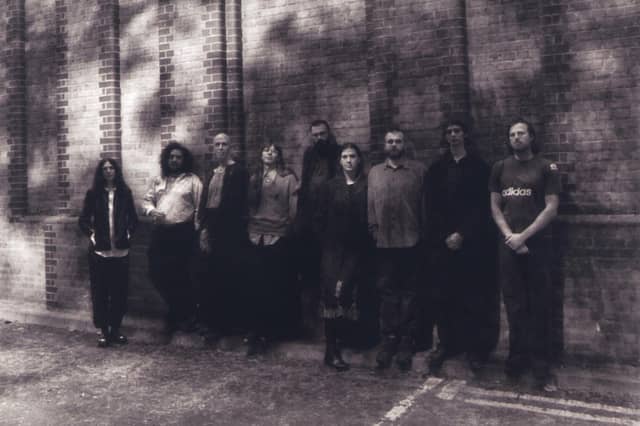

The London folk revivalists shine in concert at Huddersfield Contemporary Music Festival.
At one point during tonight’s spellbinding performance, organist and singer Nick Granata acknowledges how honoured Shovel Dance Collective are to be playing the grand confines of the Town Hall tonight as part of the Huddersfield Contemporary Music Festival.
For Huddersfield-born Granata, there is a personal significance to the venue choice: “Last time I was on this stage,” they say, “I was getting a school award for most improved in PE.”
It’s a welcome moment of levity in a 75-minute performance – steered by a medley-style patchwork aesthetic blasting bits and pieces of ancient tunes together – characterised by a white-knuckled, sinewy intensity.
The London-based nine-piece collective’s gradually growing reputation as perhaps the most gifted rejuvenators of traditional British folk song to emerge during the ongoing folk music renaissance – sealed by this year’s justifiably acclaimed LP Everything is Readiness – is certainly earned tonight.
Harp, trombone, harmonica, bass clarinet, pump organ, different varieties of banjo: the nine musicians draw textures from a bewildering array of instruments in their hugely successful mission to locate a contemporary perspective on ancient tunes that originate from dozens if not a few hundred years away.
The vast arsenal is applied sparingly: the music stretches and contracts seemingly at will, drifting unexpectedly from a drone-fuelled collective clatter to a hushed spotlight on instrument couplings: the swaying banjo and guitar duet at the end of an earnestly tender rendition of traditional ballad The Brown Girl is a particularly sparkling moment.
This is literally a collective effort, informed throughout by the group’s political conviction which connects present-day turmoil and injustice to the hardships of bygone generations of the working class these tunes were originally coined to entertain, forging a link to the progressive ideals of the late 50s/early 60s folk revival, but the contrasting timbre of the two equally authoritative lead voices can’t help but attract special attention.
Granata’s impassioned vocals quiver dramatically at the top end of the register, somewhat reminiscent of Anohni, whilst the rumblingly powerful baritone of Mataio Austin Dean (who at one point calls for more utopian songs as a response to the state of the world) evokes elemental finger-in-ear floor singers at olden times folk clubs.
As the set draws to a close with a standing ovation that follows a medley that incorporates Tally Ho! Hark Away (and which finally unleashes the group’s full capacity for uproarious cacophony) and an acapella encore singalong around Hanging Johnny, it’s fair to predict that Granata’s PE prize isn’t the only award members of Shovel Dance Collective will ever be handed.
Shovel Dance Collective’s approach perfectly complements the more playful hypnotics offered by the compelling opening performance by the Radical Polish Ansambl.
The group of six violinists (who rotate chairs after each composition in a deadpan game of musical chairs where everyone gets to sit down) and a percussionist playing a traditional Polish village drum kit 'dzaz' strip down traditional melodies from rural Poland until only the core essence remains, emphasising minimalist massed sound and propulsive repetition over individual showing-off.
At its most propulsive and palpably tense, the impact is that of legendarily muscular jazz drummer legend Elvin Jones recharging a violin sextet’s rehearsal.