
Why the Artemis II mission can be a good thing for school classrooms - Ismail Mulla
By all measures the Artemis II mission has been a success. The astronauts received a thunderous welcome home from hundreds of people involved in Nasa’s lunar comeback that set a record for deep space travel.

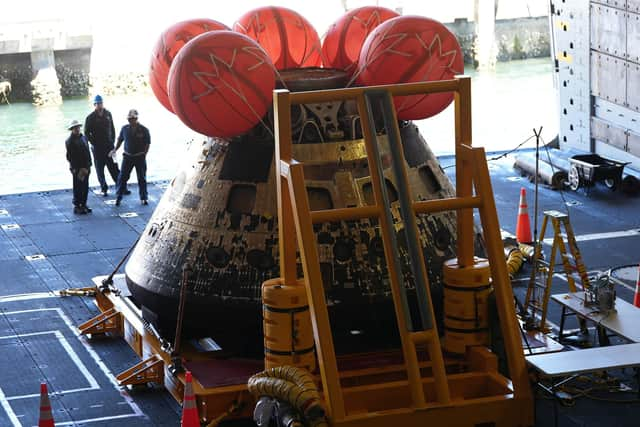
The crew of four arrived at Ellington Field near Nasa’s Johnson Space Centre and Mission Control in Houston last Saturday, flying in from San Diego where they splashed down just offshore the evening before.
During Artemis II’s nearly 10-day mission, the crew voyaged deeper into space than the moon explorers of decades past and captured views of the lunar far side never witnessed before by human eyes. They even caught a total solar eclipse.
On the record-breaking flyby, the astronauts reached a maximum 252,756 miles from Earth before completing a U-turn behind the moon, eclipsing Apollo’s 13 distance record.

The mission also revealed a new side of our planet with an Earthset photo, an echo of the famous Earthrise shot from 1968 taken by the world’s first lunar visitors, Apollo 8.
All of this, sadly, will mean nothing to a whole generation that has never lived through extraordinary chapters of space exploration.
Next up is Artemis III, which is broadly comparable to Apollo 9. It will set the foundations for a crew to once again return to the moon.
It was a reminder of what humans are capable of. The science and engineering that underpinned this mission is not to be sniffed at with Canadian astronaut Jeremy Hansen thanking the bravery of the launch teams to be “no-go” all the times they were, referring to the months of delay.
It’s worth looking back at the political pressure that was on Nasa during the original space race in the 1960s. John F. Kennedy was elected president after promising American superiority over the Soviet Union in space exploration. It went hand in hand with missile defence at a time when the Iron Curtain was still up.
How things change? Or maybe not. The world finds itself riddled with uncertainty and the tectonic plates of the global order are shifting. Conflict has once again become rife. Missiles are raining down on populations in the Middle East and parts of Europe.
Against this backdrop, some will argue what is the point of spending so much money on lunar missions. Can we not leave it to the billionaires to conquer space while we deal with issues closer to home?
Just as strong is the argument that during a climate crisis, should great resources be spent on exploring space?
But there’s something that astronaut Christina Koch said after Artemis II’s landing that will stick with people who are concerned about climate change. She described Earth as a “lifeboat”.
While there are parallels to the Apollo programme of the past, there is one aspect that has been missing from the Artemis mission. That is the sense of appointment viewing. Speak to people who lived through the first lunar missions and they all talk of knowing exactly where they were and the excitement that they felt upon seeing the grainy images projected from space.
Despite the high quality footage that we have access to these days, technology has also made human beings more fragmented. The majority of people will have just glanced at their mobile phones for updates on the mission. The latest Artemis mission will have been more of a ripple than a wave of euphoria that swept the world previously.
The importance of the mission, however, should not be underestimated. This isn’t just about space exploration. It is about what human beings can derive from it and apply here on planet Earth.
There is a real opportunity to leverage the exploits of the Artemis II crew to get children to better engage with STEM (Science, Technology, Engineering, and Mathematics) subjects. The ‘cool’ factor of space is an easy sell, surely, in classrooms. Even in the age of digital media.
In my previous life as a business journalist, the great lament of industrialists was a lack of STEM skills. It is difficult to get young people to engage with rote learning unless they can apply it to real world applications.
And if we’re to stand a chance in the fight against climate change then we’re going to need all the STEM expertise we can get. Science, engineering and technology, underpinned by maths, is what will deliver net zero. Not politicians stood on their soapbox.
The stories of the Artemis programme should inspire a whole new generation to think big. While not all of these starry-eyed young people will end up working at Nasa, hopefully many will end up doing worthy work here on planet Earth.