
'We're doing Central Banking from Leeds': Bank will soon have 500 staff in city

LEEDS is more than a footnote in the history of the Old Lady of Threadneedle Street.
In the 1820s, following a period of financial upheaval, the Bank of England decided to build a regional branch network. One of the first of these regional offices was in the heart of Leeds, which at the time was racing headlong into the industrial revolution and witnessing rapid commercial changes long before the phrase “Northern Powerhouse” came into use.
Two centuries, later the Bank's commitment to Leeds has never been stronger. In May 2024 it announced plans to increase its staff numbers in Leeds to more than 500 and, in September, it also revealed that it is set to move to new long-term premises in Leeds, Capitol House, in late 2028 to support its growth. Bank staff based in Leeds are providing economic security for the nation.
"We're doing central banking from Leeds. This isn't a support back office. This is across the breadth of our functions,” said Simon Morley, the Head of Leeds at the Bank of England: "This is a strategy not an initiative."
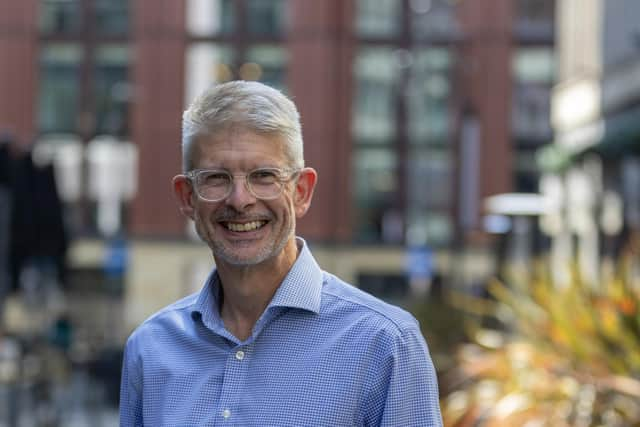

According to Mr Morley, this growth follows a decision to put a “meaningful part” of the Bank outside of London. He was proud to show off bank notes which date from the Bank’s earliest days in Leeds, a tangible reminder of central banking’s Yorkshire roots.
"It's fantastic that Leeds was the choice,’’ he said, speaking in the Bank’s current office in Yorkshire House in Leeds. “The Bank set up an operation in Leeds in 1827 to shore up confidence in bank notes by establishing a branch presence here.
"It feels like we're on the next stage of the journey in developing that presence. There is a commitment to get to 500 staff, which is truly meaningful; that's 10 per cent of the entire institution. It's across all of the institution which is another key factor.
"Leeds has got broadly the largest financial services and professional services concentration outside London in the UK. If you're looking to locate some people outside London, choosing Leeds gives you access to fantastic talent, that you might otherwise not have access to. The places with talent tend to be where ecosystems evolve and you have a concentration of a sector. Leeds has had that for a while.
"There are lots of banks and building societies here, a good legal profession, and now it has an important collection of public bodies and to add to that, the Bank, the FCA (Financial Conduct Authority) and the National Wealth Fund. You get a virtuous circle.”
Institutions attract talent; knowing you can grow a career in a region is important, said Mr Morley, who has held senior roles at the Bank for more than 17 years, after previously working at Lloyds Banking group.
“If you put all that together it seems a very logical place to do it,’’ he added.
Mr Morley was involved in the launch of the Northern Square Mile Board; a new industry-led partnership established to support the growth of Leeds and West Yorkshire's financial and professional services sector. The board brings together organisations including Lloyds Banking Group, Deloitte, Yorkshire Building Society, FinTech North and the University of Leeds behind a shared agenda to strengthen innovation, investment, skills and international connectivity across England's largest financial and professional services cluster outside London.
Supporters said the board’s formation marked an important step in the evolution of what has become known as the Northern Square Mile. The new board is part of a movement towards a more coordinated approach in shaping its growth.
"The Northern Square Mile is more than just a label,’’ said Mr Morley. “There is a concentration of talent within Leeds which is to the benefit of the broader region. It demonstrates that this is an area of growth and investment. It's a useful concept to rally behind.”
"The core of the Bank's role here is really about keeping prices stable, keeping the financial system safe and making sure that payments work for households and businesses,’’ he added. “It is for the whole of the UK. Having people who are engaged in economic analysis, banking operations and prudential regulation is really vital.
"We can now engage talent who can be part of that and make sure that we reach the right decisions. Location diversity is massively important. Technology is just an enabler...We are all aware of the benefits of diversity in reaching good judgements.
"We've just gone past 300 staff in Leeds and we have an exciting future with a bunch of milestones coming including the 200th anniversary next year. We've made a commitment to get to the 500 mark in 2027. We have good momentum and that's what we're going to achieve.”
The universities also provide a great talent pipeline to support expansion, he added.
"The aim is to move to Capitol House by late 2028,’’ he said. “It's going to be undergoing a pretty full refit, which means we'll have a modern office that supports innovation and collaboration and the decision making we need to make. In the meantime we have fantastic facilities here in Yorkshire House.”
The move to Capitol House will allow the Bank to have its own “front door” at the heart of Leeds city centre,’’ he added.
"The Bank is multi-faceted, which is why I would recommend it as a career. People believe in the broader purpose. People are proud of what we do. It's quite humbling when you think how much the UK is relying on us, from the monetary policy side to keeping the financial system safe, to making sure that the payments are working for households.”