
Yorkshire Post Health and Life Sciences Business Breakfast: Experts urge healthcare innovators to think global
Innovative healthcare businesses in Yorkshire have been advised to think big about how their products could be sold around the world.
Experts told The Yorkshire Post Health and Life Sciences Business Breakfast, in Leeds, that businesses looking to secure investment should be able to demonstrate how their innovations could work on a global level.
Yorkshire is home to hundreds of healthtech businesses, with West Yorkshire a life sciences investment zone benefitting from funding and tax reliefs.
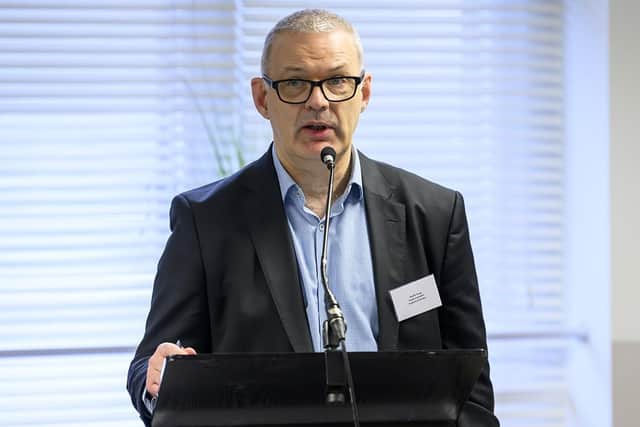
A panel discussion on how regional companies can attract investment and scale-up their businesses was chaired by Dr Neville Young, inset, director of enterprise and innovation for Health Innovation Yorkshire & Humber, who said: “I think investors like to see a global plan.”


Lizzy Young, investment manager for venture capital firm PXN Group, said: “Very seldom will the market be big enough in the UK for any technology, not just health tech.
"If any business says, ‘We're only going to sell in the UK’, the market is just not big enough for bigger scale returns.
"We're looking for, depending on the type of fund, three to five times or 10 times on our money. It just can't really be done in the UK.” Robert McGough, partner and head of the health commercial and regulatory team for legal firm Hill Dickinson, said for companies looking to expand overseas it is important to identify suitable markets and have expert support in place.
"It is having organised support to know the right regulations over there, to know the right lawyers over there.
"If you are going into foreign jurisdictions, there's different legal environments, potentially some differences in intellectual property.
"There is a lot of work to do to make the international side work. If you have 60 different markets, each of those will have different laws and regulations.
"If you've got the plan and you've got the right investment, that's a key part putting all of that together.
"You need the right package of support around you to enable you to do that as quickly and efficiently as possible, and not to waste an awful lot of money going into a territory that's not really interested in buying the products or will be quite quick to drop something.”
Richard Paxman is CEO of Huddersfield-based Paxman Group which sells scalp-cooling caps designed to prevent hair loss in cancer patients undergoing chemotherapy and does around 90 per cent of its business overseas.
He said the business is growing by around 30 per cent year-on-year and has gone from a £1m turnover business to a near £30m revenue company.
Mr Paxman while the company operates in 60 markets, he agrees with Mr McGough about the importance of focus.
"It is exciting when you first start and you’ve got all these people interested in your product and you think ‘Fantastic, we’ll sign every distributor up’.
"I don’t regret any of those decisions because it resourced our company to the next stage before doing an IPO but you do need to be much more focused.
"We’re about to launch a new product and we are primarily focused on the UK and then a couple of European markets and then the US.
"We’ve already got 1,000 cancer centres using our product there so we have a route to market.
"But research is important, as is focus and a certain amount of assistance and patience when you are entering a new market. You need the right advice, the right guidance and the right playbook.”
‘Take more risk to win NHS deals’
Healthtech companies seeking to win NHS contracts need to be willing “to take on lots more risk”, a senior healthcare boss told the event.
Joanna Rose, healthtech strategy and policy lead for NHS England, said technology suppliers should be prepared for different types of contract model than have operated previously.
She said: "We are going to expect innovators and companies to take on lots more risk. Outcome-based procurement will become more and more important and there will be an expectation that the company takes risk.”
She said this could include agreements with break clauses and accepting there will be a willingness to “let things fail fast”.
"Are you willing to put into contract that you will take on the risk of something going wrong? That is what we are going to be looking at and that will set you apart and that will lower the risk for providers or whoever is buying your product.
"Also, be really conscious of the where the benefits of your product are. One of the key blockers, which is really hard to get over, is if the cost of your product falls in a completely different area from the benefit.”