
Knaresborough Forest Park: Two phases of newt ponds and tree planting completed for Yorkshire community project to increase biodiversity

Two phases of development for the community project Knaresborough Forest Park have been completed to include newt ponds and trees with the goal of increasing biodiversity.
Long Lands Community, which owns two community woodlands, Long Lands Common (LLC) and Knaresborough Forest Park (KFP), has just completed two phases of development to enhance and increase biodiversity at Knaresborough Forest Park.
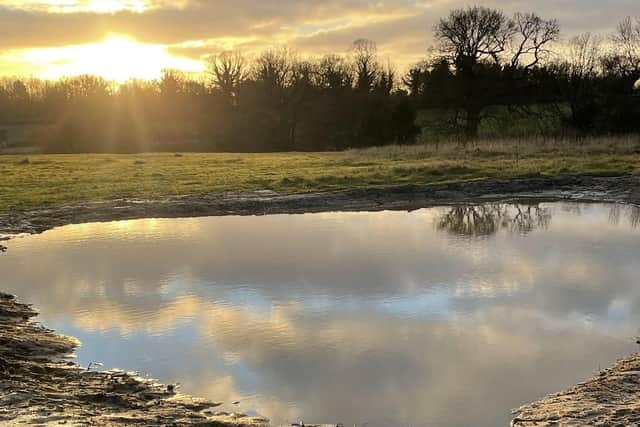
Four newt ponds were dug in November 2025 and the work is funded by the Yorkshire Wildlife Trust (YWT) in collaboration with Natural England.
YWT wetland creation officer, John Thompson, said: “Great crested newts are one of our most protected amphibians, and have suffered severe declines over the last century due to various reasons including habitat loss, pollution and fragmentation of habitats.

“As a result, our pond-building project for great crested newts is a vital way to help Yorkshire’s newt populations survive and begin to recover.”
The work was implemented by Coxon Brothers, who specialise in pond creation and built the ponds at Long Lands Common a few years ago.
Those ponds are now full of life: numerous species of dragonfly have been observed and a kingfisher has also been spotted.
The pond sites looked very bare in the beginning, but it rained heavily soon after completion and they filled with water.
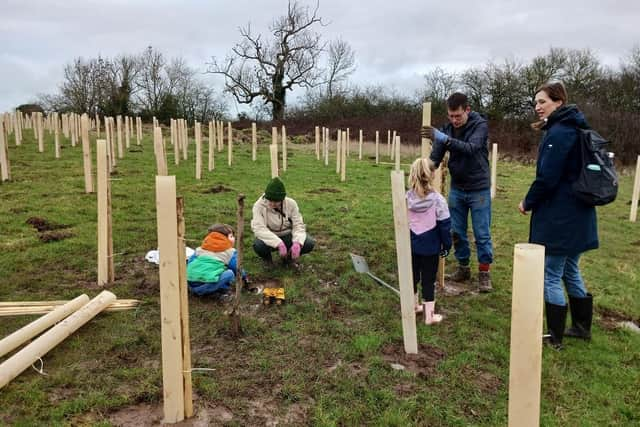
In February 2026, volunteers planted 2,000 trees in the first phase of tree planting in KFP, funded by White Rose Forest through the Trees for Climate Programme.
The preparation team and the volunteers withstood boggy conditions to bring the materials to the site and plant the trees.
KFP site lead, Geoff Freeston, said: “There was a wonderful sense of community and good will, with everyone working together to achieve this fantastic result over five planting days.
“It was great to see people bringing their families to take part – our volunteers ranged from age 3 to 87!”
The project was also supported by groups from Orb Community Arts and the Knaresborough Nidd Gorge Conservation Group, as well as some companies offering corporate volunteering.
The first phase focuses on the field to the left of the Beryl Burton Cycleway, after the second cattle grid as you walk up the hill from Knaresborough.
The design was developed from a workshop with wood-meadow ecologist, Dan Carne, as well as consultation with White Rose Forest.
The plan brings together four complementary habitats, each chosen for what it can contribute to the wider landscape.
1 - Hazel coppice, which will be used to supply straight, useful rods for craft, construction and community workshops. When coppiced, hazel will not grow too tall and will preserve the view.
2 - Riparian woodland to strengthen the existing strip along the ghyll (sunken stream). There have been 10 different species that were planted including alder, willow, birch and alder buckthorn.
3 - Wood meadow planting extends into the field. More widely spaced trees extending out into the field, including oak, alder, rowan and field maple.
4 - Mixed native hedge and low fence along the cycleway, to act as a gentle barrier to stop dogs running into the field.
The trees were supported using wooden stakes and biodegradable tree shelters made from British woodchip and wood resin. This newer type should endure longer than earlier versions which tended to degrade too soon.
This tree planting is part of the North Yorkshire Council Local Nature Recovery Strategy which has been identified a priority for this area to ‘increase tree and woodland cover by enhancing all types of existing woodland and create new species-diverse woodlands’ and ‘create and expand wood pasture habitat as an appropriate buffer and connecting habitat between woodland and grassland sites’.
Dogs have been roaming freely over the site the last few months despite having signs up alerting the public that it was primarily a wildlife reserve and asking dog walkers to keep their dogs on a short lead.
However, these signs were regularly destroyed as soon as they were up.
Their reasons behind the dog policy are:
- The site is used by ground-nesting birds, so it is important that their nests are undisturbed.
- If a dog is running loose, it is harder to pick up after it; dog faeces is classed as an environmental pollutant because of its high levels of nitrogen and phosphorus as well as parasites and chemicals from medicines and treatments.
- There are roe deer and smaller mammals on the land which dogs might chase into the undergrowth, and injure either themselves or the wild animal.
- If a dog is running through long grass, it is also at risk of picking up ticks, which cause serious diseases in dogs and humans; the UK tick season has now been extended from spring/autumn to all year round, due to the change in climate.
Dog walkers who visit KFP are required to keep dogs on a short lead, follow the mown paths and avoid areas marked off for ground-nesting birds and carry a bag and bin any dog faeces.