
'That's it': Environment Secretary rules out further farming concessions on inheritance tax
The Environment Secretary has ruled out further concessions over the introduction of inheritance tax for farming businesses, pointedly saying: “That’s it.”

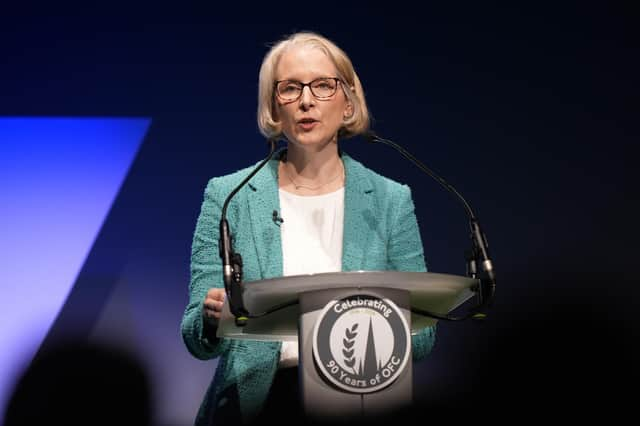
Emma Reynolds said the Government had listened to the concerns of farmers over the controversial plans to levy inheritance tax on them and had “significantly increased” the threshold at which they would have to pay the tax.
Just before Christmas, the Government announced it was raising the inheritance tax relief threshold for farmers from £1m to £2.5m in a climbdown following months of protests over the original plans unveiled in 2024.
Cash-poor asset-rich farmers had said that the original proposals would stop them from handing family farms down the generations.
When asked at the Oxford Farming Conference yesterday if farmers were right to continue to push for further inheritance tax reforms, Ms Reynolds replied: “That’s it, I’m afraid.”
While the Environment Secretary was speaking, farmers protested outside the venue and said: “Come out and talk to us.”
Ms Reynolds told the conference: “May I also say, with the greatest respect to those outside, it’s the people in this room who have engaged with us constructively, and relatively quietly, that have had an influence on this process, and not the people sounding their horns.”


Speaking to journalists after her speech, Ms Reynolds described the inheritance tax row as an issue “personal” to her and one she cares “deeply” about.
Reiterating “that’s it” for inheritance tax reforms, the Environment Secretary added she has “no idea” what message protesters outside the conference venue wanted to convey.
She said: “I have no idea what they’re saying to me, other than the sounding of horns. Beeping a horn doesn’t really give me much to go on.”
Despite the Government watering down the changes, farmers such Clare and Luke Hawes, from Thame in Oxfordshire, who were protesting, will still be forced to sell up.
The couple are due to inherit their farm from Mr Hawes’s father, but say the £700,000 inheritance tax bill they will have to pay is “unreachable”.
Mr Hawes said that, despite the recent climbdown, the tax will still unfairly impact some, particularly elderly and single farmers.
Unlike single farmers such as Mr Hawes’s father, couples with an estate worth up to £5 million can pass it down to their family tax-free.
Mr Hawes said meetings with solicitors to discuss the farm’s future have cost his family thousands and is concerned they will have to sell the farm if they cannot pay the tax.
He said: “The elderly farmers are still caught in this trap. Like my father, he’s 81, he still owns it all.
“He’s single, so he’s only got the £2.5m (tax free), so we’re still looking at a £700,000 tax bill, which is just unreachable. So we’ve got to sell up, basically.”
Mrs Hawes said: “The Government’s argument is that we would have 10 years to pay it off, but that’s still £70,000 a year that we would have to find. We don’t make £70,000 a year, so to pay that tax bill we would have to sell some of our assets – either some of our land or our livestock.
“By selling our land or our livestock, that makes our business no longer viable. We don’t have a business.
“Which means we would then have to sell our farm, which we would inherit from Luke’s dad, which means we then can’t pass it down to our children as the next generation.”
The Country Land and Business Association has said it will continue to push for the Government to scrap the policy completely.
CLA President Gavin Lane said: “Government should be congratulated for its partial climbdown, which came as a welcome relief.
“It was a further acknowledgement that their reforms were ill-thought through and deeply damaging.
"We cannot though, pull back on our campaign to reverse the policy in full, simply because what remains is still so dreadful for the rural economy.
“We are realistic about what can be achieved in the short term, but will hold all parties’ feet to the fire to ensure APR (agricultural property relief) and BPR (business property relief) are, eventually, restored completely."