
Three historic Yorkshire buildings added to Victorian Society’s top 10 endangered buildings list 2026

Victorian Society has announced its top 10 endangered buildings list for this year - and three are based within Yorkshire.
The Society’s Top Ten Endangered Buildings campaign shines a light on dilapidated and neglected buildings around England and Wales that are in need of support.
Publicity gained through this project can help to alter their fate for the better and the list is compiled through public nominations; these nominations must be in England or Wales and be built wholly or largely between 1837 and 1914.
This year, three of the buildings on the list are based in Yorkshire: former Oakes Board School in Huddersfield, St Michael’s RC Cemetery Chapel in Sheffield and Tees Transporter Bridge in Teesside.

Former Oakes Board School, Oakes Road, Huddersfield
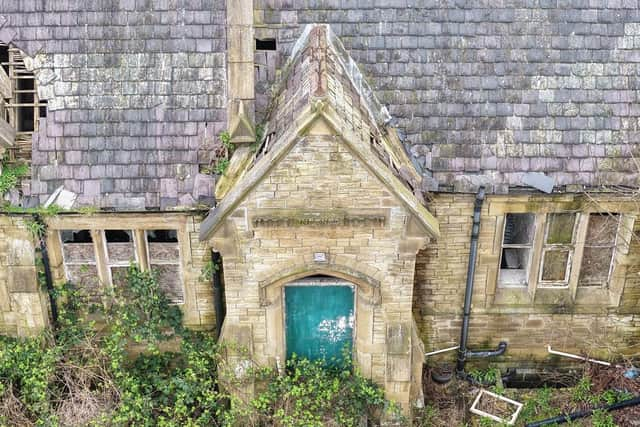
The long empty and severely decaying buildings of Oakes Board School are in an otherwise well-maintained district of surviving Victorian commercial, domestic and community buildings from the 1860s and 1870s.
This former school was built by Charles Fowler in 1873 and extended by Ben Stocks in 1885. It closed soon after 1970 and was in residential use, then utilised as the Wellington Court Residential Care Home for many years until that ended up closing down.
There have been many attempts to revive it by owners since it began decaying including placing and replacing covers over windows and door spaces, and across holes in walls as well as roofing.
The two other buildings on the site by comparison are in use including Oakes School Lodge, which is maintained and occupied.
Despite numerous requests, including from Huddersfield Civic Society and members of the Victorian Society, Kirklees Council continues not to require the owner of Oakes School to maintain this listed building.
The founding of Oakes School marked the start of state education for the masses and education had changed for children with the passing of the 1870 Education Act making school mandatory for everyone between the ages of five and 13.
Girls and boys attended elementary community schools to learn the three Rs: reading, writing and arithmetic.
They became local landmarks in districts alongside churches, chapels and pubs and Board Schools were the first state-run schools and local Boards could raise funds.
Members were directly elected, not appointed by borough councils or religious bodies. Uncommon for that period, women were eligible to win election to the School Boards.
The Victorian Society states: “Oakes School can and should find re-use.
“Kirklees Council needs to take enforcement action now. The owner should sell this re-usable building rather than continue a course of action that will lead to the building eventually falling down or having to be demolished.”
A Kirklees Council spokesperson, said: “We are aware of the former Oakes Junior School being included on the Victorian Society’s Top Ten Endangered Buildings List.
“The building is privately owned, and our Planning Compliance team has been in contact with the owner over recent months.
“This has focused on the implementation of temporary works to ensure the building remains safe, secure, and protected from further deterioration.
“The effectiveness of these works is being monitored, and we remain in ongoing dialogue with the owner.”
Griff Rhys Jones, Victorian Society president, said: “Actions speak louder than words.
“It is incredible that even in areas surrounded by good examples of preservation, where well maintained Victorian buildings add to the charm and success of an area, some forms of needless profiteering or prevarication lead to decay, neglect and steady decline.

“The council must not allow this useful, listed, and important building to be further abandoned, just because a piece of paper cannot be signed and issued. It is time for the owners to get active or get off.”
James Hughes, director of the Victorian Society, said: “Oakes School is a clear example of a building that could and should have a viable future. Its continued decline is not inevitable, but the result of inaction.
“With strong local demand and successful examples of reuse nearby, there is no reason why this building cannot once again contribute to the life of the community.”
St Michael’s RC Cemetery Chapel, City Road, Sheffield
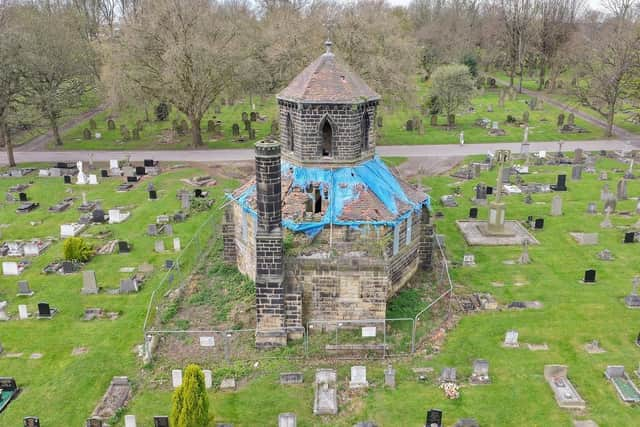
St Michael’s Roman Catholic Cemetery Chapel is a significant example of a once-common building type now in steep decline.
It has been long unused and increasingly unstable and stands at serious risk as part of a wider national pattern of neglect affecting Victorian cemetery chapels.
The Grade II-listed chapel was built by Charles Hadfield in 1898 and is one of three originally built within Sheffield’s largest municipal cemetery, reflecting the Victorian goal to create landscaped burial grounds with dedicated spaces for different denominations.
While it was designated for Roman Catholic use, the building has always been owned and maintained by Sheffield City Council. Its construction was supported by the Duke of Norfolk, a prominent Catholic patron.
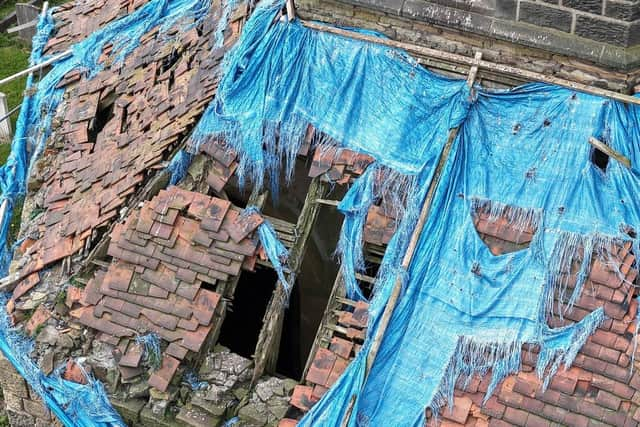
In modern times, the building has been unused for many years and is visibly deteriorating. A specialist report in 2018 identified serious structural concerns, noting that the roof was in extremely poor condition, with missing tiles, vegetation growth and likely compromised structural integrity.
Even though limited repairs have been carried out to sections of the stonework, there is no clear plan for the building’s future. According to the Victorian Society, attempts to engage both the Council and the Duke of Norfolk’s estate have failed to produce meaningful progress.
The Society stated: “The situation is particularly concerning given the wider pressures on the cemetery itself.
“Sheffield is expected to run out of burial space within the next decade, yet this historic structure, designed to support the rituals and dignity of burial, remains unused and neglected.”
The chapel’s origins lie in the Victorian response to rapid urban growth and the need for new burial infrastructure.
City Road Cemetery was designed in the tradition of the ‘garden cemetery’, combining landscaped grounds with architectural features that offered both practical and spiritual functions.
Mortuary chapels allowed mourners to gather before burial, offering dignity and ceremony within an increasingly crowded urban environment.
The Victorian Society is calling for urgent action to secure the future of St Michael’s Chapel, and others like it. Without a clear plan for repair and reuse, these buildings, once central to civic and spiritual life, risk being lost entirely.
Mr Rhys Jones said: “This is a sad story. People are still dying. Cemeteries are getting over full.
“We need space to bury our dead. And yet we have so many decaying and neglected Chapels of Rest on our books. A report comes. It is in a poor state.
“The roof is getting dangerous. But reports must be a call to arms. We still value proper burial. We all want proper respect.
“Some of that value must be turned into action to keep this fine and leading example of a garden cemetery alive and well. The graves and the Catholic community deserve no less.”
Mr Hughes said: “St Michael’s is part of a much wider and deeply concerning pattern. Cemetery chapels across the country are being lost through neglect and uncertainty over responsibility.
“These buildings were designed to serve communities at moments of great importance in people’s lives. We must now find new ways to care for them before it is too late.”
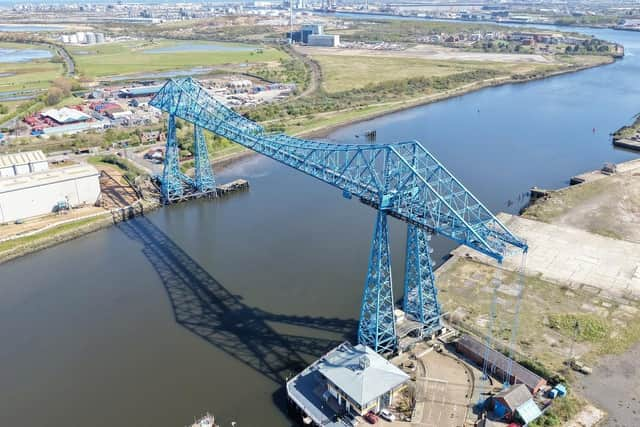
Tees Transporter Bridge, Ferry Road, Middlesbrough
The Tees Transporter Bridge - a symbol of Teesside’s industrial heritage - has been closed since 2019 due to serious structural concerns.
It spans the River Tees between Middlesbrough and Port Clarence and is one of the most recognisable engineering landmarks in the UK, however, its future is now uncertain.
The Grade II-listed bridge was built by Sir William Arrol and Co. Ltd. in 1911 and was designed to carry workers and goods across the river without obstructing busy shipping lanes.
Stretching 260 metres and standing at 225ft above water level, its distinguished gondola once transported vehicles and pedestrians across the river, a rare solution that made it one of the largest of its kind in the world.
For more than 100 years, the bridge has been both a crucial transport link. It has featured in the TV series Auf Wiedersehen, Pet, where a fictional storyline about its dismantling triggered real concern among local residents.
The Victorian Society stated: “More recently, public support for its restoration has remained strong, with overwhelming backing expressed in local consultations.
“Despite this, the bridge’s future is uncertain. Responsibility for its ownership and operation is shared between Stockton-on-Tees and Middlesbrough Councils, and the estimated £60 million required for repair and restoration is beyond their means alone.
“A central challenge remains unresolved: whether the bridge is to be treated primarily as transport infrastructure or as heritage.
“That distinction will determine what funding streams may be available, and whether the bridge can return to operation.
“The Victorian Society is calling for a co-ordinated national response to secure the bridge’s future. Whether as a functioning crossing or as a conserved monument, this extraordinary structure must not be allowed to fall into permanent disuse.”
Tees Valley Mayor Ben Houchen said: “The Transporter Bridge is one of the most recognisable landmarks in the country and holds a special place in the hearts of local people. For over a century it has stood as a symbol of Teesside's proud industrial heritage and remains an iconic part of our identity.
“The bridge is managed by Middlesbrough Council under an agreement with Stockton Council, and Tees Valley Combined Authority has allocated £30 million towards essential repairs to the structure. However it's also clear that additional funding will be required and we will therefore continue to work closely with both local authorities on how best to secure its future.
“Any decisions about the long-term future of the Transporter Bridge must ultimately be made by the people of Teesside, Darlington and Hartlepool. This is their bridge, and the public must be closely consulted before any final decisions are taken.”
Mr Rhys Jones said: “You don’t need me to tell you that people love this bridge. It is a symbol. It is a monument.
“And more than that, it is a link and a potential working part of Stockton and Middlesbrough. Got to be saved. Got to be operational again.
“If we can find money for new bridges, we can find money for this great survivor and all that it means.”
Mr Hughes said: “The Tees Transporter Bridge is one of Britain’s most remarkable feats of engineering and a defining landmark of the North East.
“Its future cannot be left to uncertainty. A clear strategy, supported at national level, is urgently needed to secure both its structure and its continued role in the life of the region’.”