
Port Mulgrave: The derelict former ironstone exporting port in Yorkshire where visitors go fossil hunting

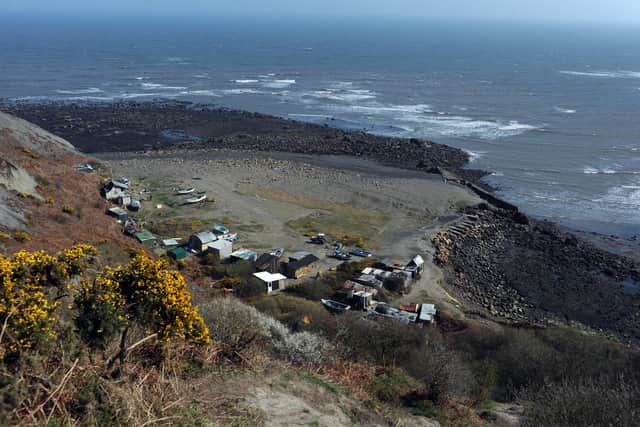
Port Mulgrave is a secluded hamlet that used to be an ironstone exporting port along the North Yorkshire coast between Staithes and Runswick Bay - and it is a popular place for fossil hunting.
There are rows of domestic properties and houses that exist on the top of the cliff at Port Mulgrave and the remains of the harbour can still be found below the cliff.
It used to be known as Rosedale and was renamed Port Mulgrave after the local landowner the Earl of Mulgrave to avoid the mix up between ironstone mines and iron works at Rosedale in the middle of the North York Moors.
Port Mulgrave used to be an ironstone exporting port, a coastal harbour specially developed to ship mined iron ore out to regional or international ironworks and steel mills.

History of Port Mulgrave
An ironstone mine was opened at Rosedale Wyke, Port Mulgrave, by Sir Charles Palmer in the 1850s with ironstone loaded onto small vessels from a wooden jetty.
A harbour was built by Sir Palmer in 1856-1857 which cost £45,000 and originally the harbour distributed ironstone to Jarrow on Tyneside to supply Palmers Shipbuilding and Iron Company Limited. Later ironstone was sent to fire up furnaces by the River Tees.
Grinkle ironstone mine was used near the hamlet of Dalehouse when the mine at Rosedale Wyke started to diminish and a narrow-gauge railway line was constructed to the mine in 1875.
The ironstone wagons from Grinkle Mine were taken over bridges then through a tunnel under Ridge Lane.
The wagons were led onto a tall, bridge-like overhead framework supported by towers called a gantry with bunkers on the east harbour wall ready for loading the ironstone directly into ships in the harbour.
The tunnel entrance at the harbour can still be seen but it is boarded up. In 1911 the pier gantry and boiler house were damaged by a serious fire, though it was repaired.
In 1916 Grinkle Mine was connected to the Whitby, Redcar and Middlesbrough Union Railway, avoiding the wartime hazards of shipping and the tramway tunnel abandoned.
Port Mulgrave was a popular port for 40 years but the harbour was redundant by 1920 due to the railway link and cheaper foreign sources of ironstone becoming available.
The harbour was left derelict after falling into disuse and in 1934 Grinkle Mine was abandoned, then the harbour machinery was sold off as scrap and the gantry accidentally destroyed by a fire.
To prevent it being used as part of any German invasion during the Second World War, the west harbour breakwater wall was intentionally destroyed by the Royal Engineers.
Geography of Port Mulgrave
The geology of the cliffs is Whitby Mudstone Formation on top of Cleveland Ironstone Formation with remains of jet in the shale.
The official way people can access the beach is by walking down a steep path leading to a wooden ladder.
There have been coastal erosion, landslips and path closures and in 2022, the steps down to the beach collapsed during a landslip.
Due to its secluded nature, the area is considered a hidden gem and often visited by fossil hunters. Ammonite, dinosaur and reptile fossils can be found on the foreshore, this makes it a Site of Special Scientific Interest.
However, it is dangerous to dig fossils out of crumbling cliffs and screes. The beach is composed of rock, sand and stones.