
Balaclava-clad troublemakers causing 'blight on our neighbourhoods' say police
Cleveland Police have acknowledged that balaclava wearing youths are a “blight on our neighbourhoods” and say they are working collaboratively with partner organisations to tackle the issue.
Both Middlesbrough and Redcar and Cleveland Councils are drawing up new balaclava-related public space protection orders (PSPOs) which could see offenders who refuse to comply with being asked to take them off fined, or potentially hauled before the courts.
Meanwhile, Redcar councillor Peter Grogan said he wanted to see a complete ban on balaclavas and recently submitted a successful council motion prompting views to be gathered from police and the local crime commissioner, while also encouraging local MPs to raise the matter with the Government.
Last month Nottingham became one of the first cities in the UK to introduce restrictions on balaclavas, allowing police and community protection officers to ask people to remove them if they “reasonably believe” they are being used to conceal their identity to commit crime or anti-social behaviour.

Anyone refusing to comply could face a £70 fixed penalty notice or be prosecuted through the courts with a potential fine rising up to £1,000.
The enforcement will not apply to face coverings worn for legitimate reasons, including religious, cultural, health, work, weather or personal safety reasons.
Police there said the problem was “substantial” and “predominantly involved very young people, normally young males wearing balaclavas, and sadly, in a lot of circumstances, they are involved in drug dealing [and] carrying weapons”.
Daryll Tomlinson, Superintendent for Redcar and Cleveland, said: “Cleveland Police are dedicated to keeping our communities safe and tackling criminals.
“Working with partners to make effective use of the full range of powers available helps to keep our streets safe, and we will continue to work collaboratively with the local authority and the police and crime commissioner on any proposed interventions.
“Balaclavas, in particular, can be used to conceal identities and can cause fear and alarm within our communities.
“They are often associated with other forms of anti-social behaviour, such as the use of off-road bikes, and are a blight on our neighbourhoods.”
One problem for the authorities will be effective enforcement – it will be up to officers to determine whether or not coverings are being worn legitimately.
Many young criminals are also highly likely to ignore restrictions with another difficulty being actually catching them since “ballies” are often worn by people travelling at speed on bikes, motorbikes and off-road vehicles.
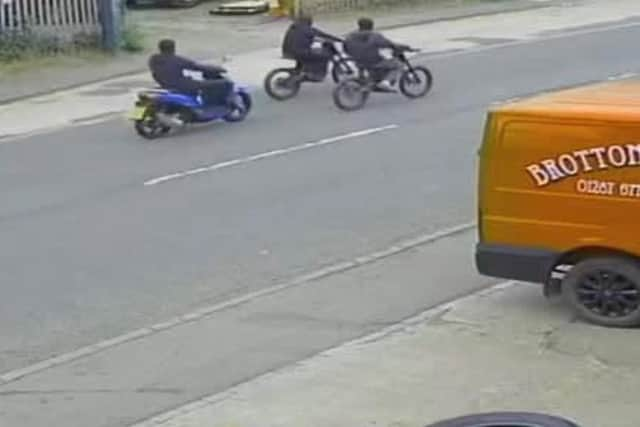
Last month East Cleveland councillors on Facebook called for “strong, permanent and visible policing” in the area with the post being accompanied byphotos of balaclava-clad youths on motorbikes taken in Brotton – such images having become synonymous with fears about lawlessness in some parts of Teesside.
The Local Democracy Reporting Service asked the office of Cleveland Police and Crime Commissioner Matt Storey for his views and if there had been contact from Redcar and Cleveland Council following the motion.
But a spokeswoman for the PCC saidno correspondence had been received to date and it would be “pre-emptive” to comment prior to this.