
Groundbreaking documentary reveals actual location of Battle of Stamford Bridge

After two years of investigations, History Hit has released a documentary claiming to reveal the exact location of the Battle of Stamford Bridge.
“We can reveal a new chapter in the story of a day when the future of the kingdom turned on a spear point,” says presenter Dan Snow in a trailer shared online.
Considered one of the greatest battles in British history, it was previously assumed that the Anglo-Saxon and Norwegian armies fought at the village of Stamford Bridge in the East Riding of Yorkshire.
On September 25, 1066, King Harold Godwinson successfully defended the English throne by defeating the Viking king, Harald Hardrada. In four days, Godwinson famously travelled 185km with his army to catch Hardrada by surprise.
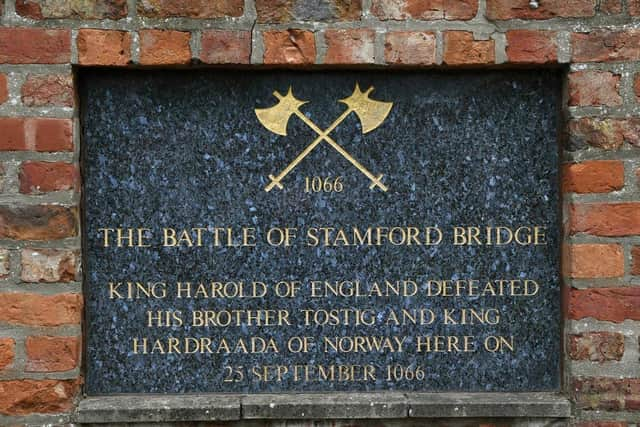

Yet, over 1000 years later, archaeologists have found no artifacts at the modern site, leaving the exact location of the battlefield a mystery.
The History Hit documentary, ‘1066: The Lost Battlefield,’ premiered on September 8, 2026.
The episode follows lead metal detectorists, Simon Richardson and John Benfield, documenting their discovery of a large number of military artifacts near an old Roman bridge, approximately a mile south of Stamford Bridge.
Assisted by the Battle of Stamford Bridge Heritage Society, the investigators searched the River Derwent and agricultural fields near the village of Low Catton.
The unearthed 11th-century weaponry includes spearheads, a Viking sword scabbard, and mail armour.
According to History Hit, the concentration of artifacts “pinpoints the battlefield approximately one mile from its traditionally accepted location.”
The documentary was aired just days before the Bayeux Tapestry was displayed to the British public for the first time on September 10, 2026.
Following his success at Stamford Bridge, ill-fated Godwinson was defeated three weeks later by William the Conqueror at the Battle of Hastings.
Across 58 scenes, the Bayeux Tapestry depicts William the Conqueror’s conquest of England, including his victory at Hastings.
The tapestry is currently displayed at the British Museum in London.