
Special Report: The long and winding track of the Leeds tram saga
The many twists and turns of the Leeds’ tram saga - how it ended up as the largest city without a mass transit system

When Boris Johnson said, in 2019, that it was a ‘scandal’ Leeds was the largest city in the Western Europe not to have a mass transit system, few in West Yorkshire disagreed.
But while there may have been widespread agreement, there was no widespread surprise.
It is an albatross the city has worn throughout the various chapters of the decades-long Leeds tram saga.
The latest iteration - to connect Leeds and Bradford, with a second line running through the city centre is in some ways an evolution of the schemes which came before, albeit with a Bradford arm bolted on.
But getting the job done, and finally shedding the un-asked-for millstone, will depend on lessons being learned from the attempts which fell by the wayside.
When we talk about trams coming to Leeds, we should in actual fact be talking about trams returning to the city.
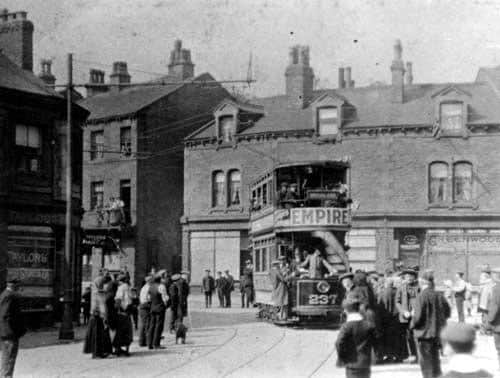
The Leeds Corporation Tramways once covered huge swathes of the city, covering a far greater area than the latest proposals.
At its peak, 25 lines branched all over the city, reaching Morley in the South, Guiseley in the North West and Cross Gates in the East.
To the West, it connected near Pudsey with the Bradford Tramway, meaning commuters could travel from one city to the other with comparative ease.
In 1891, when the first parts of the network were launched, single-decker trams were pulled by horses, before steam trams briefly came into operation.
These ran until full electrification, which was used until the network was abandoned on November 7 1959.
This left Sheffield as the last English city with an operating tram network, for one year at least until that too closed in 1960.
After a decade or two of relative quiet on the tram front, as the motorcar revolution of the 70s and 80s took full flight, voices began to grow in support of a new, reimagined tram network.
This project would later become known as the Leeds Supertram which, despite years of lobbying and millions of pounds spent, would come to an ignominious end.
The idea was to have a three-line, 17-mile system, going from Bodington in the North to Tingley in the South, and out to Grimes Dyke in the East, with a loop running round the city centre.

It got the green light under Tony Blair’s Government in 2001, and the proverbial spades went into the ground two years later in 2003, when preparatory work was done at City Square and at the junction of the A61 and A639.
But a year later, concern started to grow over the escalating costs, with fears the £500 million originally allocated could swell to £1 billion.
Cutbacks were made, routes were shortened and £250 million in savings were found.
But despite this, to the dismay of regional leaders at the time, the then transport minister Alistair Darling cancelled it altogether, despite £40 million already having been spent.
A decade on, one of the leading brains behind the project, Kieran Preston, would tell the Yorkshire Post the business case for the Leeds tram had been far stronger than those for Nottingham or Manchester, but that the Labour Government had in effect cooked the books to say Leeds could not afford it.
Ultimately, regardless of the various machinations, Leeds was back to square one.
Almost immediately, plans began being drawn up for an alternative - the Leeds Trolleybus, a scaled down project based on a system already in operation in Lyon.
At £300 million, it would have had three routes: To a park and ride site at Bodington in the North; a park and ride in Stourton in the South, and a route from the city centre to Saint James’ Hospital.
A business case was submitted to Gordon Brown’s Government in 2009, with ‘programme entry approval’ granted in 2010.
But it faced significant local disapproval, with the inquiry into the scheme receiving 1,700 letters - believed at the time to be the most in a decade.
Ultimately, following a negative report from the mandatory public Inquiry, the proposed scheme was cancelled under David Cameron’s Government in May 2016
The final nail in the coffin was the negative report from the public Inquiry, which found while there was a “strong need to improve public transport in Leeds”, “the applicants have not demonstrated that the scheme would meet key objectives of supporting significant economic growth, reducing congestion and greenhouse gas emissions, or enhancing the quality of life in the area it would serve”.
The albatross returned, and the wait goes on for Leeds to shed its oft-repeated title.