
Yorkshire's economy can benefit from region leading way on climate action: Asif Husain-Naviatti
The Yorkshire Post Climate Summit 2025 took place last week, now in its fifth year. I had the immense privilege of hosting it. For those in the room, it offered a rare breadth of perspectives – on technology and energy, on green and future skills and new job creation, on transport and infrastructure and on the investibility in nature-based solutions.
Whether or not we use the language of climate change directly, these are the engines and drivers of innovation and building a better future. They create the conditions to achieve greater efficiency; they open up new opportunities in places facing industrial decline; and they unlock new avenues for investment and more equitable growth. If we do it well, they also make our cities, towns and homes more healthy, clean and liveable.
We heard this at the summit in very practical terms: from investment in nature-based solutions to reduce and prevent flooding – and increasing reality in the Yorkshire region – to the electrification of transport and accompanying changes in behaviour. The evidence sits clearly in the region’s Climate Action Plan, produced by the Yorkshire and Humber Climate Commission (YHCC), which I chair. Based on independent research, it shows that targeted investment aimed at reaching net zero by 2038 in the region can deliver £250bn of co- benefits by 2050. The largest gains may lie in the mental and physical health value of enabling more engagement with nature.
Listening to the speakers and panellists last Thursday, the momentum behind this agenda is far beyond theoretical, and it is already happening.
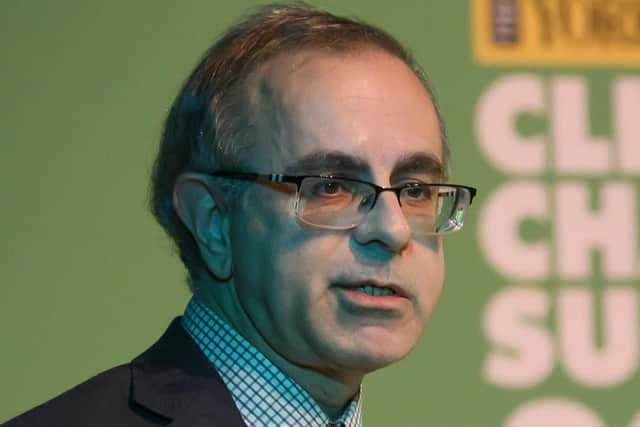

While many of the summit speakers came from businesses, I was struck by the diversity of sectors represented in the room – from public bodies, universities, community and civil society organisations, to private individuals – all demonstrating clearly a shared sense of mission. I saw the same earlier this month when I had the similar privilege of hosting the YHCC Gathering. Over 120 participants attended, representing not only the YHCC, but also Climate Commissions and Partnerships across the region – Leeds, Barnsley, Calderdale, York, Wakefield, Bradford and Lincoln. It was quite a remarkable display of regional climate leadership: different sectors, acting in concert, behind a single purpose. This was one huge team. And for every person who could be in those rooms – the Climate Summit and the Climate Gathering – just imagine how many more actors lie behind and alongside them, though unable for a variety of reasons to attend on a particular day. That gives a far truer sense of the scale and momentum of climate action already under way in and around Yorkshire.
This matters because Yorkshire has both the potential and the power to lead the way, and to contribute materially to realising the UK’s national climate goals. No other region contains so much within one geography: vast natural assets – moors, dales, forests, woodland and rivers – a productive agricultural base, and some of the nation’s major industrial heartlands. The region is also home to some of the UK’s most deprived communities. Yorkshire’s opportunities and Yorkshire’s challenges are therefore the country’s opportunities and challenges. With a population of around 5.5 million, it holds a significant part of the national puzzle. Nor should the UK Government underestimate the power of placed-based action – national targets will not be met without it. Local and regional implementation is where ambition turns into delivery. Everyone who attended the Climate Summit and Climate Gathering has a role in that delivery. And with the latest developments in national legislation through the devolution bill, there is an opportunity to unlock this potential.
The Climate Summit highlighted, in various ways, the enabling conditions and processes necessary for progress – from planning and incentives to awareness of both climate mitigation and adaptation, from partnerships and joined-up approaches to regulatory environments. The message was clear: awareness and progress are strong, but there is room for improvement.
Profit and purpose need not conflict; they can complement each other, benefiting stakeholders, employees, customers, communities, and the environment.
As the summit demonstrated, there are sound opportunities for business, whether through technological innovation, the development of new skills, or access to cheaper, cleaner energy. But there is another critical and growing imperative that businesses are beginning to recognise: resilience – the ability and the need to adapt to a changing climate. The key point is this: building resilience to climate change risk is not the cost of doing business – it’s the essence of staying in business.