
Keighley and Worth Valley Railway: ‘The Railway Children helped revive our Yorkshire heritage railway 56 years later’
Keighley and Worth Valley Railway was first used as a filming location for The Railway Children in 1970 and since then the heartwarming story has attracted an ‘influx of visitors’ to the heritage railway.

Noel Hartley, 50, originally from Pendle, Lancashire, started working as a volunteer at Keighley and Worth Valley Railway when he was just 11 years old with his father and worked his way up to the business and operations manager role he’s in now.
The railway first opened in the 1860s and was predominantly used by local mill workers during the cotton trade to transport goods away from the area as well as a connection to Keighley for passengers.
As it flourished, the population of the area grew significantly connecting Keighley, Bradford, Skipton, Halifax and other areas surrounding them.
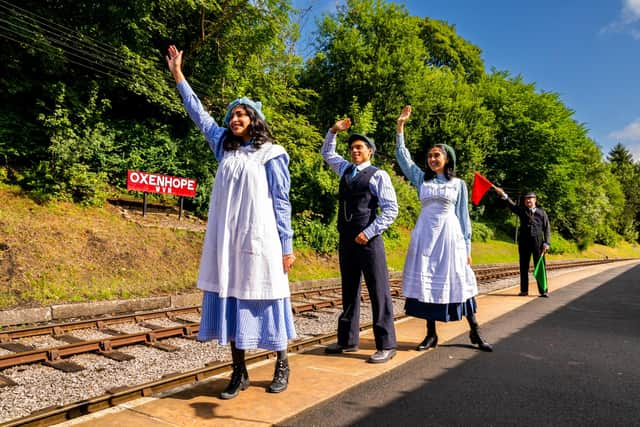

However, in the 1960s following a review by the British Railways it was found that the Worth Valley branch to Oxenhope didn’t make any money and they decided to shut it down.
Residents in the area who were passionate about the railway built a society and ultimately saved the railway.
In 1968, the railway reopened and co-founder, Bob Cryer, was approached by a production company that wanted to film The Railway Children and the rest is history.
“I would say that was the major cornerstone for the railway between becoming a fledgling railway preservation movement to what it is now,” Mr Hartley said.
“Had we not had the massive influx of visitors after The Railway Children, it would have probably been a much more steady growth.
“We were blessed with that film tourism that happened in the 1970s because that meant that we had to push ourselves to expand, we had to increase the capacity of the railway to cope with the visitor numbers.
“It meant that the railway became much bigger and that carried on through the 70s, 80s and 90s - the railway grew quite nicely in that time.
“It was a really good news story at the time and a great way of showing off steam engines and heritage railways to the world.”
During the 1990s there was a shift in tourism and shopping habits changed over the weekends and numbers of people visiting the railway dropped off by the mid-1990s.
This continued until mid-2015 when railway volunteers realised they needed to change things.
“We’ve changed the way we approach our commercial activities,” Mr Hartley said.
“One of the biggest things that we did was being open to doing big projects; one of those big projects ended up being the filming of The Railway Children Return which happened in 2021.
“That was all in the middle of Covid, so it made a big difference in the way that our business changed post-Covid as well.
“We saw visitor numbers grow from around 95,000 people in 2019 to 105,000 people in 2022. From there we went from 105,000 to 125,000 the year after.
“Last year in 2025 we reached 140,000 visitors; most of that was down to the fact that we had The Railway Children theatre show here as part of the Bradford 2025 City of Culture programme.
“One of the biggest things that’s still a major attraction to the area is The Railway Children, so it made sense to bring that show back to where it belonged.”
Mr Hartley said that the demographic of visitors has changed a lot since the beginning.
“The recent Railway Children film had a more diverse cast,” he said.
“We are actively looking to appeal to a wider and more diverse audience. If we were looking at our audience base maybe 30 years ago it would be a much higher proportion of more stereotypical railway enthusiasts who remembered steam trains running in the 1960s.
“Some of the people we now attract are just looking for that kind of experience of what it used to be like but don't have any previous experience [themselves], while other people may have travelled on a heritage railway as a child.
“We do everything we can to make it a full day out for them and have as many different attractions as possible; we’ve got a playground, we’ve got museums, exhibition spaces, we’ve got places to eat and drink.
“It’s all packaged up in our offer for a well-rounded visitor attraction rather than just being about the train ride itself. We also want to do a wide variety of events that appeal to wide, diverse audiences.”
Building on the legacy of the Bradford 2025 project and The Railway Children films is the next step, Mr Hartley said.
“The original film is still shown every Christmas without fail on TV, so it’s still appealing to new audiences every year,” he said.
“There’s been a huge amount of hard work into building on its success; our approach has been very much around becoming a sustainable organisation.
“That includes working out when our peaks and troughs are, making sure that whatever we’re doing is as efficient as it can be and coming up with new ideas and ways of bringing new audiences into the railway.
“The Railway Children has been one of those ways of bringing an existing audience back and also building on that as well to attract new people who have got that interest.
“We can’t put all our eggs in one basket and I think that’s the main thing that we’ve learned is that to be successful we have to have different ways of pulling these audiences in.”
A lot has happened over the last four years including Keighley and Worth Valley Railway being named ‘Event of the Year’.
“Last year it had a massive impact on our numbers for the year; it was a great success, not just because of visitor numbers but it actually showed the railway off in an amazing light,” Mr Hartley said.
“We’ve just been awarded ‘Event of the Year’ for the Railway Children last year by our trade association.
“Our heritage railway association does awards each year across the whole heritage rail sector.”