
Roberts £59.99 wind-up radio offers alternative to cheap emergency gadgets


This article contains affiliate links. We may earn a small commission on items purchased through this article, but that does not affect our editorial judgement.
Emergency radios are flying off the shelves as households respond to new Government advice. But with unfamiliar brands flooding online marketplaces, I've found a reassuringly straightforward £59.99 alternative from one of Britain's best-known radio manufacturers.
Wind-up radios are suddenly one of Britain's most sought-after gadgets, with retailers reporting soaring demand and some models selling out following new Government advice urging households to prepare for emergencies.
At least seven models were reported sold out across four retailers over the weekend, while electronics retailer Maplin saw torch sales rocket by 284% and purchases of portable power banks more than double.
The rush follows the Government's new 'Be Ready' campaign, which recommends keeping emergency supplies at home in case severe weather, cyber attacks or other incidents disrupt electricity, communications and essential services.
But there's something I've noticed while looking at the growing selection of emergency radios available online. Suddenly, there seems to be an endless choice of devices from brands I've never previously heard of, many promising an extraordinary collection of features at remarkably low prices.
Some have solar panels, powerful torches, phone chargers, flashing emergency lights and all manner of other extras. They certainly sound impressive, but when it comes to a piece of equipment you might genuinely need in an emergency, I'm more interested in one thing: will it do its basic job reliably?
I've already tested one of the popular budget wind-up emergency radios available on Amazon, the £29.99 Ryichi, and found plenty to like about its collection of practical features. But I also wanted to see what was available from a manufacturer with a longer track record.
That's why I've been looking at the Roberts R9957S wind-up emergency radio, priced at £59.99 directly from Roberts, a British radio specialist with a history stretching back to 1932.
It doesn't try to do everything, but perhaps that's precisely the attraction.
Why I'd choose a Roberts over an unfamiliar brand
Roberts is one of those British names that needs little introduction, particularly if you grew up with a portable radio playing in the kitchen or garden.
Founded by Harry Roberts and Leslie Bidmead in 1932, the company started by producing just three radios a week. More than nine decades later, it's still one of the best-known names in British audio, famous for its distinctive retro designs and long association with portable radios.
The company has also held Royal Warrants, which says something about its standing in the industry.
Of course, a famous name isn't an absolute guarantee that every product will perform perfectly. But personally, if I'm buying something specifically to provide information when the power goes off, there's reassurance in choosing a manufacturer with decades of experience making radios rather than taking a chance on a brand with little visible track record.
The Roberts R9957S portable radio takes a rather different approach from many of the inexpensive emergency gadgets appearing in online searches.
It's designed first and foremost to be a radio, with the essential emergency functions built around that purpose.
What does the Roberts R9957S actually offer?
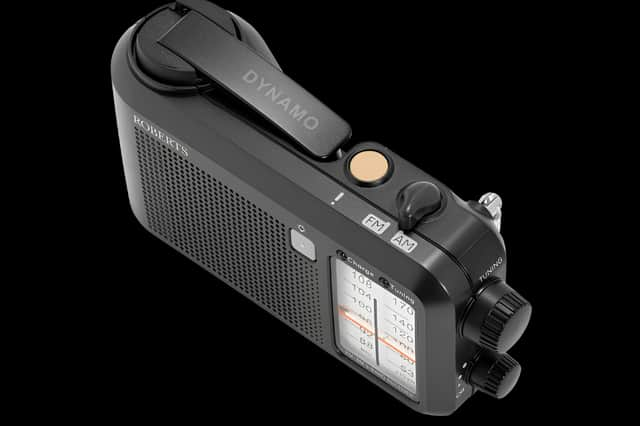
The R9957S is a compact, traditional-looking portable analogue radio weighing just 329g, making it light enough to keep in a drawer, emergency supplies box, rucksack or car.
It receives both AM and FM broadcasts, with a telescopic aerial for FM reception and an internal ferrite rod aerial for AM stations.
That matters because radio reception is the whole point of buying one of these devices. During a power cut, the ability to receive news and official information without relying on Wi-Fi, mobile data or a television could be enormously useful.
Controls are pleasingly straightforward. There's a traditional rotary tuning dial, clearly labelled settings and a volume control, so you don't need to navigate complicated menus or electronic displays.
It also has a backlit tuning dial, useful if you're trying to find a station in poor lighting, and a headphone socket for private listening.
There is even a built-in emergency buzzer that can be activated to attract attention if you need assistance.
None of these features is revolutionary, but they're all relevant to the job the radio is intended to perform.
How does the wind-up charging work?
The most important feature, given the Government's advice, is the built-in hand-crank dynamo.
The Roberts can operate using AA batteries, while the internal rechargeable battery can be powered by turning the crank. That gives you an alternative source of electricity when ordinary batteries are exhausted or mains power isn't available.
It's an appealingly simple arrangement. In an emergency, you don't need a wall socket or sunny weather to generate enough power for some additional listening time.
The hand crank isn't intended to provide unlimited listening without effort, and Roberts doesn't publish a specific number of minutes of radio use for each minute of winding on its main product page.
But the principle is sound: having a manually powered backup means the radio isn't entirely dependent on the electricity supply.
For anyone putting together an emergency kit, I'd keep spare AA batteries alongside the radio as well. That provides a convenient first option, leaving the crank as a backup.
What about the torch, solar panel and phone charger?
Here's where the Roberts differs most noticeably from many of its cheaper rivals.
There isn't a large built-in torch, no solar panel to recharge the battery and no USB power-bank function for charging your phone.
At first glance, that might make it seem less attractive than an all-in-one emergency radio promising six or seven different functions.
The Ryichi wind-up radio I reviewed recently, for example, costs £29.99 and manages to squeeze a solar panel, LED reading light, spotlight, SOS alarm and emergency phone-charging facility into its compact body.
I was impressed with the Ryichi during testing, and for anyone wanting a versatile emergency gadget at a modest price, it makes a compelling case for itself.
But I'm not convinced that having fewer features necessarily makes the Roberts a worse choice.
The Government's emergency checklist already recommends having a separate torch and portable phone charger, and there's a perfectly reasonable argument for keeping those devices separate from your radio.
After all, if you're using a radio's limited battery to charge your phone or run a bright LED light, you're potentially reducing the power available for its main purpose: receiving information.
And while solar panels have their uses, a tiny panel on a portable radio isn't going to provide much help during a gloomy winter evening.
I would rather have a dependable radio, a decent torch and a properly charged power bank than expect one small gadget to handle everything.
That's not to say multifunction emergency radios are a bad idea. They can be extremely convenient, particularly for camping or travel, but simplicity has its attractions when reliability matters.
How much does the Roberts emergency radio cost?
The Roberts R9957S is currently available for £59.99 directly from Roberts Radio, making it roughly twice the price of the £29.99 Ryichi I tested.
That's a significant difference, particularly when the cheaper radio offers substantially more functions on paper.
But the question is whether you're prepared to pay more for an established manufacturer's name, a straightforward design and a device that concentrates on radio reception rather than trying to be a miniature survival centre.
For me, that's a reasonable proposition, although buyers should be aware that a prestigious brand alone doesn't prove superior reception or long-term reliability.
Why the Government wants everyone to have an emergency radio
The Government's latest advice recommends that households prepare for disruption to essential services and keep enough basic supplies to manage for three days.
Alongside food, drinking water, medication, torches and portable phone chargers, its checklist specifically includes a battery-powered or wind-up radio.
The reasoning is straightforward. During a widespread blackout, televisions may stop working, home broadband connections can fail and mobile phone networks may become unreliable.
A traditional analogue radio offers an alternative means of receiving information, provided broadcasters remain operational.
It's a simple precaution, but one that appears to have taken much of the country by surprise.
Government survey findings published earlier this year showed that only 23% of respondents had an FM radio capable of running on batteries, solar power or a hand crank, excluding car and mobile phone radios.
That leaves plenty of households potentially looking to buy one for the first time.
Is the Roberts R9957S worth £59.99?
There's something rather reassuring about a product that doesn't promise the earth.
The Roberts R9957S isn't trying to be a camping lantern, phone charger, solar generator and radio all rolled into one. It's a compact AM/FM radio with a wind-up power source, conventional battery option, illuminated tuning dial and emergency buzzer.
It's also made by a company that has been designing radios for 94 years.
If you're looking for the maximum number of features for the minimum outlay, the cheaper Ryichi is arguably the more attractive proposition. Having tested that model myself, I certainly wouldn't dismiss it simply because the brand is less familiar.
But if your priority is a straightforward emergency radio from a long-established British manufacturer, the Roberts makes a convincing alternative.
At £59.99 from Roberts Radio, it's certainly not the cheapest way to tick the Government's emergency radio recommendation off your list, but it could appeal to buyers who value simplicity and an established name over additional gadgets.
I've always believed that good emergency equipment should be uncomplicated. You want to know where it is, know how it works and have confidence that it will be useful when you need it.
And when it comes to something as fundamental as keeping up with the news during a power cut, I think there's a lot to be said for choosing a proper radio from a company that has been making them for generations.