
Ribblehead Viaduct: History of Yorkshire structure that carries Settle to Carlisle railway line and inspired ITV period drama Jericho

The Ribblehead Viaduct carries the Settle to Carlisle railway line and inspired the ITV period drama Jericho - here’s its history.
The Ribblehead Viaduct, also known as the Batty Moss Viaduct, was built by the Midland Railway and is considered the longest and third tallest structure on the Settle to Carlisle line at 28 miles.
The Grade II listed structure was designed by John Sydney Crossley, who was also responsible for the construction of all major structures along the line.
The viaduct was going to be closed permanently by British Rail during the 1980s before lobbying by the public saved it in 1989.
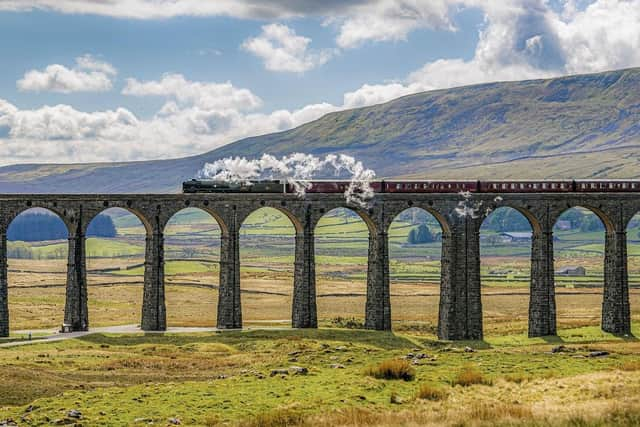

The construction history of the viaduct was the inspiration behind the 2016 ITV period drama series Jericho and it appeared in the 1970 film No Blade of Grass as well as the 2012 film Sightseers.
It was also featured in the Channel 5 series Yorkshire Great and Small that stars Helen Skelton and Dan Walker last year.
History of Ribblehead Viaduct
During the 1860s, the Midland Railway decided to build a line between Settle and Carlisle due to the growth in rail traffic between England and Scotland.

The purpose of the railway line was to join the Midland line between Skipton and Carnforth to the city of Carlisle and in July 1866, the Midland Railway Act was passed by parliament, permitting the company to ‘construct railways from Settle to Hawes, Appleby, and Carlisle; and for other purposes’.
Once the Act was passed, the Midland Railway came to an agreement with the London and North Western Railway (LNWR), to run services on the LNWR line.
The construction started in late 1869 during which time more than 100 men lost their lives either due to construction work, fighting or outbreaks of smallpox.
There are around 200 burials of men, women and children in the graveyard at Chapel-le-Dale and the church has a memorial to the railway workers, according to Church of England records.
The Settle to Carlisle line was the last main railway in Britain to be built primarily with manual labour.
In November 1869, a contract to construct the Settle Junction to Dent Head Viaduct section including Ribblehead Viaduct was assigned to contractor John Ashwell.
The approximate cost of the construction was £343,318 and by July 1870, work had begun on the foundations for Ribblehead Viaduct.
The viaduct was built by a workforce of up to 2,300 men who lived, often with their families, in temporary camps named Batty Wife Hole, Sebastopol, and Belgravia on adjacent land.
In December 1872, the design for Ribblehead Viaduct was changed from 18 arches to 24, each spanning 45ft. By the end of 1874, the last stone was laid.
In September 1874, the first train carrying passengers was hauled across by the locomotive Diamond and the viaduct was opened for freight traffic in 1875.
The following year in May, the whole line opened for passenger services.