
Fears farmer or firefighter will die before Government pays attention to moor fires
A farmer or a firefighter will die before the government pays attention to “what is really going on on the moors” it has been claimed, amid fears the consequences of a fire which burned across 10 square miles of the North York Moors will be swept under the carpet.

Experts, scientists and organisation chiefs have called for lessons to be learned and a review of the government’s stance on moorland management as Labour this week further restricted controlled burning.
It comes as the fire on Langdale Moor, now under investigation by North Yorkshire Fire and Rescue service, started in a forestry block which was not actively managed and spread across unmanaged moorland.
It had been burning for weeks and was being tackled by fire crews from across North Yorkshire with the help of farmers and game-keepers in searing summer temperatures, beset by more than 18 explosions happening around them due to World War Two munitions from an old army training camp.
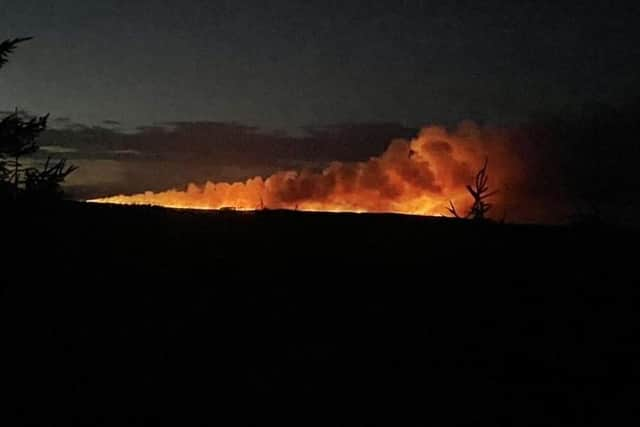

The situation escalated dramatically on Monday August 25 when the blaze jumped a fire break and spread rapidly across the moorland towards farms and properties.
Despite this, it was announced on Tuesday, that from September 30, there will be a ban on controlled burning of heather on peatland at a depth of more than 30cms rather than the current 40cms limit.
When the 40cms limit was imposed in 2021 it led to a 73 per cent reduction in management through burning and a drive to reduce grazing sheep on the moors has led to 600,000 tonnes of extra vegetation each year, posing its own fire risk
Andrew Gilruth, chief executive of countryside organisation The Moorland Association said: “The whole thing has become a mess.”
He launched a scathing attack on Natural England and Defra for making rules on wildfires despite not employing wildfire experts.
Mr Gilruth said: “There should be a public inquiry into what is really going on on the moors and why we have land managers begging to be given the tools to cut the risk being dictated to by the state.
“Voices which need to be heard are not being heard at the moment. Natural England has no wild fire experts but get to say a great deal.
"Defra has no wildfire experts but says a great deal. RSPB says a great deal but doesn’t employ wildfire experts. The National Trust doesn’t have a wildfire expert and the list goes on.”
The Yorkshire Post has seen letters from the Moorland Association which were sent to the then Home Secretary, Yvette Cooper in January, the then Deputy Prime Minister, Angela Rayner in April and the Health and Safety Executive (HSE) in July.
They expressed concerns and warnings over excessive fuel loads caused by heather and vegetation on moorlands across the UK, fumes from out of control wildfires and a fragmented approach to tackling and preventing wildfires.
As Tuesday’s ruling was announced, Defra said local communities will benefit from improved air quality, adding: “These new measures will create resilient peatlands that are naturally protected from wildfires.”
Mr Gilruth added: “We would never do this in an urban environment. The same rules need to be applied to the countryside but the terrifying fact is, no-one will pay any attention to this until a farmer, a fire-fighter or a game-keeper is killed.”
He was backed by University of York scientist, Andreas Heinemeyer who is leading a 20 year study into the impact of different moorland management options.
Dr Heinemeyer said emotions being brought into policy-making had resulted in biodiversity “being burned to a crisp”.
“Natural England has an internal push against grouse moors.
“Too much emotion has gone into policy and that is why it has gone wrong. We need to ask what is the proper evidence, without emotion, for the outcomes we all want,” he said.
Natural England said it was working to find out the extent of the damage from both the fire and the necessary emergency works which took place to stop it spreading.
When asked by The Yorkshire Post about reviewing land management practices, a spokesperson added: “Once we know more, we will continue to work with landowners and land managers on the short and long-term measures needed to restore the special features of the North York Moors.”